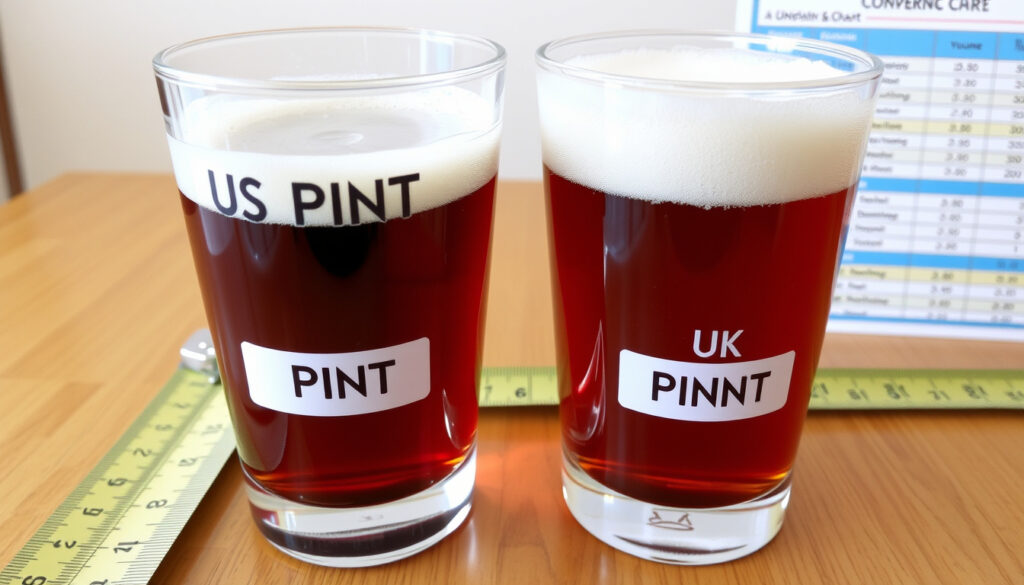
How Many Ounces in a Pint? US vs UK Pint Conversion
You’re at a bar, thirsty, and you order a pint. But what you get depends entirely on which side of the Atlantic you’re standing. A US liquid pint holds 16 fluid ounces, while a UK imperial pint packs 20. That 4-ounce gap might seem small, but it’s a difference that has tripped up cooks, brewers, and berry buyers for nearly two centuries. This guide untangles the three kinds of pint—US liquid, US dry, and UK imperial—so you know exactly how many ounces you’re dealing with.
US liquid pint to oz: 16 oz (473 ml) ·
UK imperial pint to oz: 20 oz (568 ml) ·
US dry pint to oz: 18.6 oz (551 ml) ·
US half pint to oz: 8 oz ·
UK half pint to oz: 10 oz
Quick snapshot
- US liquid pint = 16 fl oz (473 ml) (Britannica)
- UK imperial pint = 20 fl oz (568 ml) (Britannica)
- US dry pint = 18.6 fl oz (551 ml) (NIST)
- US half-pint = 8 oz; UK half-pint = 10 oz (Britannica)
- Some US bars serve 14 oz glasses as “pints” — not legally enforced
- Origin of discrepancy between ale and wine gallons before 1824 is debated among historians
- 1824: UK Weights and Measures Act redefines gallon → 20 oz imperial pint
- 1893: US adopts Queen Anne wine gallon → 16 oz US liquid pint
- UK retains pint for beer and milk by law (EU directive 1995)
- Dry pint remains standard for US agricultural goods
Six pint variations, one key takeaway: the same word means different volumes depending on the system and the substance. The table below lines them up.
| Label | Value |
|---|---|
| US liquid pint in oz | 16 oz |
| UK imperial pint in oz | 20 oz |
| US dry pint in oz | 18.6 oz |
| US half-pint in oz | 8 oz |
| UK half-pint in oz | 10 oz |
| Pint legislation UK | 1985 Weights and Measures Act |
Is a pint 16 or 20 oz?
The answer is both—it depends on which pint you’re talking about. Let’s break it down.
US Liquid Pint: 16 oz
- The US liquid pint is one-eighth of a US gallon of exactly 231 cubic inches, yielding 16 US fluid ounces (The Oxford Companion to Beer).
- That equals 473.176473 milliliters, per the US customary system (Wikipedia).
UK Imperial Pint: 20 oz
- The UK imperial pint is one-eighth of the imperial gallon (277.419 cubic inches) and equals 20 imperial fluid ounces (The Oxford Companion to Beer).
- That’s 568.261 milliliters (Britannica).
Why the difference?
The split dates to 1824, when the UK redefined its gallon under the Imperial Weights and Measures Act, creating a larger pint. The US kept the older Queen Anne wine gallon (231 cubic inches) as its standard, so the US liquid pint remained 16 oz (The Oxford Companion to Beer).
If you’re traveling between the US and UK, a pint of beer in London is 20% larger than one in New York. Ordering a “pint” without specifying the system can cost you—or give you less than you expect.
The implication: the 16 oz vs 20 oz question is not a matter of right or wrong—it’s a matter of jurisdiction. The US system uses two kinds of pint (liquid and dry), while the British system uses a single pint for both dry and liquid measure (Britannica).
Is 1 pint equal to 8 ounces?
Only if you’re talking about a half-pint. Here’s how that works.
Only a half-pint equals 8 oz in the US
- A US half-pint is exactly 8 fluid ounces, half of the 16 oz US liquid pint.
- Commonly used for small servings of milk, cream, or beer flights.
UK half-pint equals 10 oz
- In the UK, a half-pint is 10 imperial fluid ounces, half of the 20 oz imperial pint.
Common half-pint uses
Half-pints are typical for children’s milk portions in the UK and for small beer samples in both countries. A full pint is never 8 oz.
What this means: if a recipe calls for “half a pint,” you need to know which country’s pint you’re halving. The difference is 2 oz—enough to throw off a delicate sauce.
How many oz in a pint of beer?
Beer drinkers, this one’s for you. The pint glass you’re handed depends on where you order.
US pint of beer: 16 oz
- A standard US pint glass holds 16 fluid ounces. However, some bars serve “pints” in 14 oz glasses, a practice that is not legally enforced (Reddit discussion).
UK pint of beer: 20 oz
- A UK beer pint glass holds 20 imperial fluid ounces. The UK government strictly regulates these measures under the Weights and Measures Act.
What about Guinness?
Guinness is served in imperial pints (20 oz) in Ireland and the UK. In the US, it’s typically poured into a 16 oz pint glass, so the serving size is smaller.
Beer lovers crossing the Atlantic: a US “pint” of Guinness is 4 oz less than the original Irish serving. Order a “schooner” (half-pint) in the UK if you want a smaller, legal measure.
The trade-off: US bars benefit from cost savings on smaller pours, but consumers lose out. In the UK, the pint is a protected measure, ensuring you get what you pay for.
How many oz in a pint of blueberries?
Blueberries and other fruits are often sold by the “dry pint,” which is a volume measure, not a weight measure. This causes confusion.
Dry pint vs liquid pint for berries
- A US dry pint is defined as 33.6 cubic inches (0.551 liter) by NIST (NIST HB 44).
- That’s about 18.6 fluid ounces by volume, but the weight of the berries varies.
1 dry pint equals about 18.6 oz by volume
By volume, a dry pint is 18.6 US fluid ounces. But when you buy blueberries, the weight is typically around 12 ounces per dry pint, because berries don’t pack tightly.
Why volume and weight differ
The USDA uses the dry pint for agricultural goods like blueberries, strawberries, and grains. A dry pint container holds the same volume as a dry pint, but the actual weight depends on the product’s density. For example, a pint of blueberries weighs less than a pint of flour.
Why this matters: if you’re baking and a recipe calls for “a pint of blueberries,” using a liquid pint measure (16 oz volume) would give you less than the intended dry pint. Always check whether the recipe assumes dry or liquid measure.
How many ounces in a pint UK?
For anyone cooking or drinking in the UK, this is the essential conversion.
UK imperial pint = 20 fluid ounces
- The UK pint is legally defined as 20 imperial fluid ounces, equivalent to 568.261 milliliters (Britannica).
- An imperial fluid ounce is smaller than a US fluid ounce (28.4 ml vs 29.6 ml), so the actual volume difference is even greater than a simple 4 oz count suggests.
Why the UK kept the larger pint
When the UK began metricating in 1965, the pint was retained for draft beer, cider, and milk. A 1995 EU directive allowed the UK to continue selling beer and milk by the pint (The Oxford Companion to Beer).
Metric equivalent: 568 ml
For metric kitchen scales, remember: 1 UK pint = 568 ml. A US pint is 473 ml. That 95 ml difference (about 3.2 oz) is critical for precise recipes.
The pattern: the UK’s commitment to the imperial pint is a cultural and legal choice, not a relic. It’s enshrined in the 1985 Weights and Measures Act and remains the standard for pub and dairy trade.
Timeline: How the pint split happened
- 1707: British ale gallon defined as 282 cubic inches, separate from the wine gallon.
- 1824: UK Weights and Measures Act redefines imperial gallon as 277.42 cubic inches, creating the 20 oz imperial pint (The Oxford Companion to Beer).
- 1893: US adopts the 1707 Queen Anne wine gallon (231 cubic inches) as standard, so US liquid pint remains 16 oz (The Oxford Companion to Beer).
- 1965: UK begins metrication but retains pint for draft beer and milk.
- 1995: EU directive allows UK to continue selling beer and milk by the pint.
What’s clear and what’s not
Confirmed facts
- US liquid pint = 16 oz (473 ml) (Britannica)
- UK imperial pint = 20 oz (568 ml) (Britannica)
- US dry pint = 18.6 oz (551 ml) (NIST)
- US half-pint = 8 oz
- UK half-pint = 10 oz
What’s unclear
- Some US bars serve 14 oz glasses as “pints” — not legally enforced.
- Origin of the ale vs wine gallon discrepancy before 1824 is debated among historians.
Quotes from the experts
“The US liquid pint is equal to 16 US fluid ounces, while the UK imperial pint is 20 imperial fluid ounces.”
Britannica
“The imperial pint is about 20 percent larger than the US liquid pint.”
The Oxford Companion to Beer
“NIST distinguishes between liquid pint and dry pint when necessary for trade.”
NIST Handbook 44
For US shoppers and UK travelers alike, the choice is clear: know your system before you pour or measure. A US pint of water is 16 oz; a UK pint of milk is 20 oz. For blueberries, the dry pint (18.6 oz by volume) is the standard. Always check the label—or you’ll end up with less than you bargained for.
conversion.org, yeegolife.com, 100daysofrealfood.com, scribd.com, desertislanddishes.co, facebook.com, nottingham.ac.uk
Frequently asked questions
How many ounces are in a US pint of water?
16 US fluid ounces (473 ml).
How many ounces are in a UK pint of milk?
20 imperial fluid ounces (568 ml).
Is a dry pint the same as a liquid pint?
No. A US dry pint is 18.6 fluid ounces by volume, while a US liquid pint is 16 fluid ounces.
How many ounces in a pint of oil?
Oil is usually measured by fluid ounces. A US liquid pint of oil is 16 oz; a UK pint is 20 oz.
How many ounces in a pint of Guinness?
In Ireland and the UK, a pint of Guinness is 20 imperial oz. In the US, it’s 16 US oz.
Why do US and UK pints differ?
The UK redefined its gallon in 1824, creating a larger pint. The US kept the older wine gallon, so the US pint stayed smaller.
How many ounces in a half-pint of beer?
In the US, 8 oz; in the UK, 10 oz.
Related reading
- Steps in a Mile: Guide to Walking and Running — Another conversion guide for everyday measurements.
- Turkey Pot Pie Recipe: Flaky, Creamy & Foolproof — A recipe where pint and ounce measurements matter.
More related posts
 Posiciones de Atlético Nacional – 1st in Liga BetPlay 2026
 Search Obituaries by Name: Free Lookup for Ireland & U.S.
 Timberwolves vs 76ers Player Stats: Scoring Leaders & Analysis
 What to Do Near Me – Best San Diego Weekend Activities
 Charlie Kirk in Casket: Key Verified Funeral Details
 Is Dolly Parton Sick? 2025 Health Truths & Updates
 Thời tiết ngày mai: Tomorrow’s Weather Vietnam Forecast
 Dallas Cowboys vs Carolina Panthers Match Player Stats – Box Score & Key Highlights