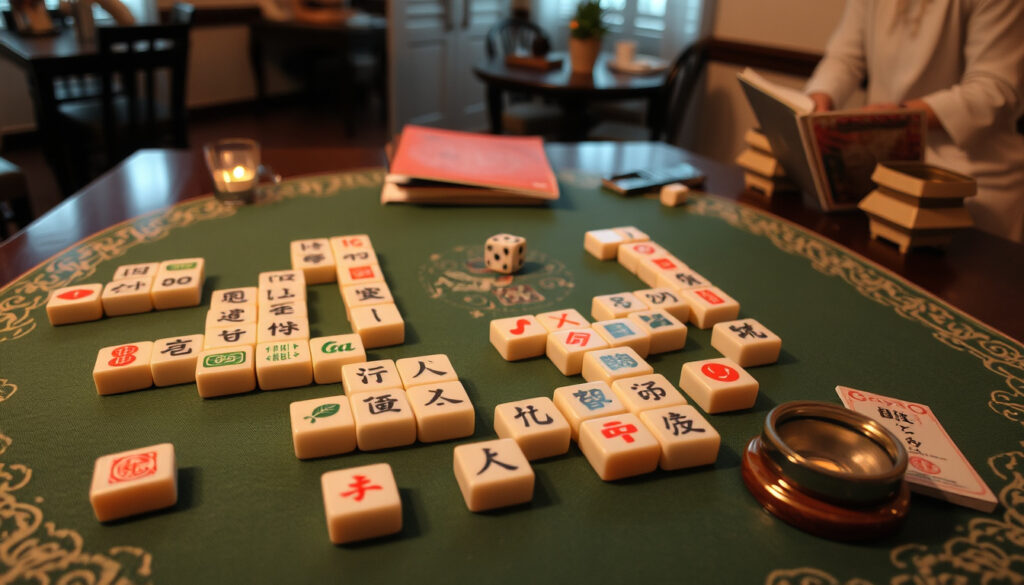
How to Play Mahjong: Step-by-Step Rules for Beginners
Few board games spark as much curiosity and confusion as Mahjong, with 144 tiles and multiple rule sets. This beginner’s roadmap gives you the core rules, common pitfalls, and a clear path from fumbling to playing comfortably.
Number of tiles in standard set: 144 · Players per game: 4 · Origin: China (19th century) · Common variants: American, Japanese, Chinese
Quick snapshot
- Exact origin story — multiple legends exist (Wikipedia)
- Whether the game was invented by a single person or evolved over time (Wikipedia)
- First known rulebook: 1895 (China) (Wikipedia)
- World Mahjong Organization founded: 2005 (Wikipedia)
Five key numbers, one pattern: the game is older than most people realize, but the core structure has stayed remarkably stable. Here’s a quick reference table.
| Measure | Value |
|---|---|
| Standard tile count | 144 |
| Players per game | 4 |
| Average game duration | 30–60 minutes |
| Year of first known rulebook | 1895 (China) |
| World Mahjong Organization founded | 2005 |
How do you play mahjong step by step?
- Set up the tiles and walls: each player builds a wall of 36 tiles, forming a square. The dealer breaks the wall and deals.
- Understand turn order: the dealer starts with 14 tiles; all others receive 13. Play proceeds clockwise.
- Draw and discard tiles: draw from the wall or call melds from discards (chow, pung, kong). After calling, discard one tile.
- Form a winning hand: complete four melds and a pair to call mahjong.
Five key numbers, one pattern: the game is older than most people realize, but the core structure has stayed remarkably stable. Here’s a quick reference table.
Setting up the tiles and walls
The standard set contains 144 tiles divided into three suits — bamboo, characters, and dots — plus honor tiles (winds and dragons) and bonus tiles (flowers and seasons) (Wikipedia). Each player builds a wall of 36 tiles (18 stacks of two) in front of them, forming a square. The dealer, determined by dice roll, breaks the wall and begins dealing.
Understanding the turn order
Play proceeds clockwise. The dealer starts with 14 tiles; all other players receive 13 (The Mahjong Project (beginner guide)). The dealer discards one tile to the center of the table, then each player in turn draws a tile from the wall and discards one. The goal is to form a winning hand of four melds and a pair.
Drawing and discarding tiles
On your turn, you draw a tile from the wall. If it completes a meld with tiles already in your hand, you may call out and take the last discarded tile instead (Playground Equipment (kids’ guide to mahjong)). Melds include chow (three consecutive tiles of the same suit), pung (three identical tiles), and kong (four identical tiles). After calling or drawing, you must discard one tile to keep your hand at 13 (or 14 for the dealer before the first discard).
Forming a winning hand
When your hand consists of four melds (each is a chow, pung, or kong) plus a matching pair, you have a winning hand — often called mahjong. You declare the win by discarding the last tile needed and showing your complete hand (The Mahjong Project (basics)). In American Mahjong, the National Mahjong League publishes a yearly card that specifies which hands are valid (Wikipedia).
How easy is mahjong to learn?
Is mahjong difficult to learn for beginners?
Mahjong has a moderate learning curve. The basic turn sequence is straightforward, but tile recognition and scoring rules can trip up newcomers. Many beginners find the hand patterns and scoring complex because each variant uses a different point system (Masters Traditional Games (rules resource)). In American Mahjong, the yearly card changes the allowable hand combinations, adding an extra layer of memorization.
Why is mahjong so difficult to learn?
The difficulty stems from three factors: the number of tiles (144), the different meld types you need to recognize quickly, and the scoring variations across Chinese, Japanese (Riichi), and American styles. A Hong Kong guide recommends starting with Hong Kong Mahjong because of its simpler scoring (Dear Asia Mahjong (variant breakdown)).
Can I learn Mahjong by myself?
Yes. Self-study is possible with rulebooks, mobile apps like Mahjong Soul or Riichi City, and video tutorials (FRVR (variant guide)). Many apps let you play against AI, which automates turn order and scoring so you can focus on pattern recognition. The US National Mahjong League also offers study materials for the American version.
Mahjong is simple on the surface but deep in practice. A new player can learn the basic turn in 10 minutes but may need dozens of games to recognize winning patterns quickly. The difference between a beginner and a competent player is about 5–10 practice games online.
What’s the best mahjong strategy?
Defensive play vs. offensive play
Good Mahjong players balance building their own hand while denying tiles to opponents. The most fundamental rule: discard tiles that are least likely to help others form melds (Wikipedia). In Japanese Riichi Mahjong, the “riichi” call (declaring ready hand) puts you in a high-risk offensive stance but earns bonus points.
Reading opponents’ discards
Watch what other players discard. If someone discards a tile from a suit early, they may be avoiding that suit. Keeping notes on discards helps you infer what hands they might be building (Playground Equipment (guide)).
Hand efficiency and waiting patterns
Prioritize building a hand that matches the scoring table of the variant you are playing. In American Mahjong, refer to the current NMJL card. In Riichi, the “dora” indicator tiles add extra value, so aim to incorporate them when possible. A common beginner error is holding onto tiles that are already dead (already discarded by others), which wastes the potential for future melds (The Mahjong Project (basics)).
Discarding efficiently is the single most underrated skill. Beginners often throw away tiles that complete an opponent’s chow or pung, effectively playing for the other side. Check the discard pile before you toss — if three players have passed on a tile, it’s probably safe.
Why do old ladies play mahjong?
What is the controversy with the game mahjong?
Mahjong gained popularity among older women in the United States during the 1920s and 1930s, when Jewish and Italian immigrant communities adopted the game as a social activity (Wikipedia). The game also faced controversy: in China, Mahjong was banned during the Cultural Revolution for its association with gambling, and even today some jurisdictions restrict online play. In the US, early 20th-century moralists criticized the game for encouraging frivolity.
Social and cognitive benefits of mahjong
Regardless of demographics, Mahjong provides significant social interaction and mental stimulation. Studies have linked regular play to improved short-term memory and pattern recognition in older adults (Wikipedia). Community centers and retirement homes often host weekly games, reinforcing the game’s role as a social glue.
How to play Mahjong online?
How to play Mahjong online free
Several platforms offer free online Mahjong, including Pogo, Mahjong Soul, and Riichi City. These services automate rules and scoring, allowing you to focus on gameplay (FRVR (variant guide)). Most also include tutorials and practice modes.
How to play Mahjong on phone
Mobile apps are widely available for both iOS and Android. Riichi City and Mahjong Soul support multiplayer, while apps like “Mahjongg” from PopCap offer single-player against AI. The advantage of mobile play is that the app enforces the rules, so you don’t need to memorize every detail to start playing (FRVR).
How to play Mahjong Blast?
Mahjong Blast is a casual mobile game that combines traditional Mahjong Solitaire with power-ups. It is not traditional Mahjong — it is a single-player matching puzzle using the same tiles (YouTube (instructional video)). Beginners sometimes confuse this with the real game; treat it as a tile‑familiarization tool rather than a simulation of 4‑player play.
How to play Mahjong with 2 players?
How to play Mahjong Solitaire
Mahjong Solitaire is a single-player tile‑matching puzzle that uses the traditional tile set. The goal is to remove all tiles by matching identical pairs from an exposed layout. It is not standard Mahjong — there are no melds, no opponents, and no scoring system (Wikipedia). It is, however, a popular way to learn tile recognition.
Rules for two-player Mahjong
Official Mahjong is designed for four players, but two-player variants exist. One common adaptation: each player controls two positions (East/West and South/North), effectively playing two hands simultaneously (Masters Traditional Games (rules)). Another version, known as “Sparrow,” simplifies the rules to two‑player competition with reduced tile counts. These adaptations sacrifice some strategic depth but allow a quick two‑player game.
The original Chinese game is the simplest and is presented as a skillful form of the game.
— Masters Traditional Games (rules guide)
The banker starts by discarding the 14th tile they do not want into the center of the table.
— The Mahjong Project (basics guide)
The player designated East is determined by dice and takes the first turn after the deal.
— I Love Mahj (American Mahjong getting started)
The Charleston exchange phase is a unique feature of American Mahjong.
— Oh My Mahjong (beginner guide)
The pattern: Every expert source agrees on the same advice — learn one variant, play a few practice games online, and only then dive into strategy. The trade‑off for beginners is simple: spend 30 minutes learning the turn cycle, then invest a few hours in an app to internalize hand patterns. Those who skip the app stage often give up before the game clicks.
Related reading: **How to Make a Resume: 7 Steps & CV vs Resume Differences**
Frequently asked questions
What is the difference between American and Chinese Mahjong?
American Mahjong uses jokers, a yearly hand card from the National Mahjong League, and a Charleston exchange phase before play. Chinese Mahjong (Hong Kong style) has no jokers, simpler scoring, and no Charleston (Masters Traditional Games).
How many tiles do you start with in Mahjong?
The dealer starts with 14 tiles; all other players start with 13 (The Mahjong Project).
What is a ‘mahjong hand’?
A mahjong hand is a winning hand consisting of four melds (chow, pung, or kong) plus a matching pair (Playground Equipment).
Can you play Mahjong with 2 players?
Yes — through variants like Sparrow or by having each player control two positions, but the standard game is designed for four (Masters Traditional Games).
Is Mahjong luck or skill?
Both. The tile draw introduces luck, but skilled players consistently win through defensive discarding, pattern recognition, and hand planning (Wikipedia).
What is the ‘dead wall’ in Mahjong?
The dead wall is a set of tiles set aside from the main wall that are not drawn during regular play. Kong declarations and certain bonus tiles are drawn from the dead wall in some variants (Wikipedia).
How do you score points in Mahjong?
Scoring varies by variant. In American Mahjong, points are awarded based on the hand card; in Riichi, points come from hand value plus dora and yaku; in Hong Kong Mahjong, scoring is simpler and based on fan (multipliers) (Masters Traditional Games).
What is the National Mahjong League card?
The National Mahjong League (NMJL) publishes an annual card that lists all valid winning hands for American Mah Jongg. Players must use the current year’s card in official games (Wikipedia).
For a beginner in the US, starting with American Mahjong (using the NMJL card) is the most practical path — you will find more physical players and online resources tailored to that variant. For casual solo play, Mahjong Solitaire apps are a low‑pressure way to get comfortable with tile recognition. Either way, the hardest part is dealing with the first hand; after that, the patterns become intuitive. The alternative — reading rulebooks without ever playing — is where most beginners get stuck.
More related posts
 Is Raikou of the Dragons Real? The Truth Behind the Meme
 Golden State Warriors vs Dallas Mavericks Match Player Stats
 When Is Trump’s Birthday? Date, Age & Celebration Details
 Instant Pot Air Fryer: Reviews, Models & Ninja Comparison
 How to Do No Caller ID on iPhone, Android & Samsung
 From Dusk Till Dawn Cast: Full List, Ages, Trivia (1996)
 Where to Watch The Daily Show: Streaming Options in 2025
 New Zealand National Cricket Team vs India Match Scorecard