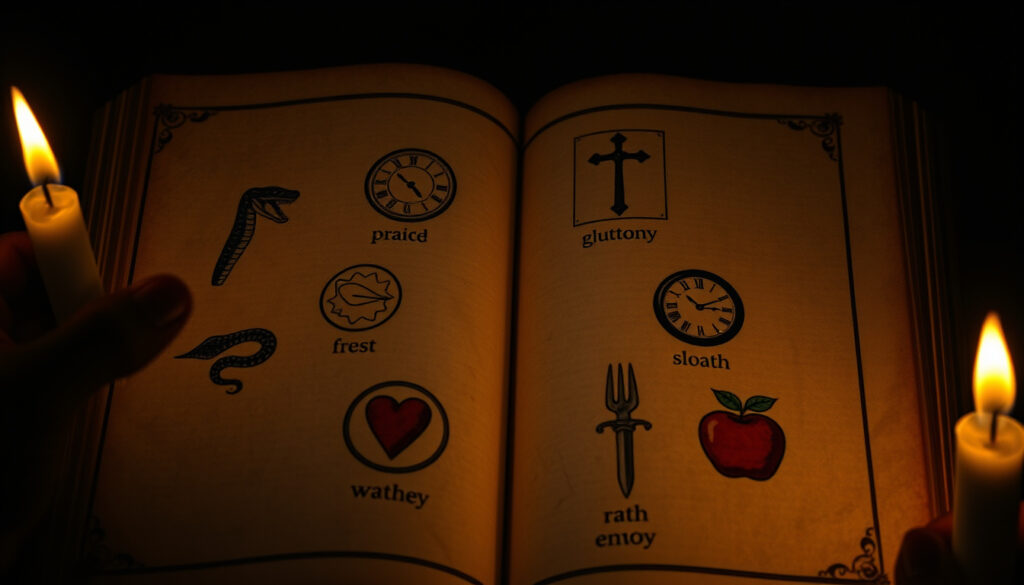
7 Deadly Sins: Meanings, Order & History Explained
Most people can name at least a few of the seven deadly sins — pride, greed, lust — but few realize this famous list didn’t come straight from the Bible. It emerged from the dusty cells of fourth‑century monks trying to diagnose spiritual illness, and over centuries it was polished by popes, poets, and pop culture — this guide traces where the list really came from, what each sin means, and why it still resonates today.
Number of sins: 7 ·
First listed by: Evagrius Ponticus (4th century) ·
Finalized by: Pope Gregory I (590 AD) ·
Used in popular culture: Anime, movies, books
Quick snapshot
- The seven deadly sins are pride, greed, lust, envy, gluttony, wrath, and sloth (Britannica)
- Pope Gregory I formalized the list in 590 AD (Britannica)
- Whether the Eastern Orthodox list should include eight sins rather than seven (Britannica)
- Whether sloth is simple laziness or deeper spiritual acedia (The Thoughtful Catholic)
- List formalized by Pope Gregory I in 590 AD, later popularized by Dante’s Divine Comedy (Britannica)
- Modern culture continues to adapt the sins — new interpretations appear in psychology, film, and video games (Britannica)
The seven deadly sins weren’t invented to scare people — they were a practical diagnostic tool for monks. Understanding their origin helps separate medieval psychology from modern moral panic.
What are the 7 deadly sins in the Bible?
Are the seven deadly sins directly mentioned in the Bible?
The short answer: no. The phrase “seven deadly sins” never appears in the Bible. The concept is a later Christian framework that grew from early monastic teachings rather than from a single scripture passage (Bibleinfo).
Which Bible verses are associated with each sin?
While not grouped together, individual sins are condemned throughout the Bible. Proverbs 6:16‑19 lists seven things the Lord hates — haughty eyes, a lying tongue, hands that shed innocent blood — which some commentators connect to the deadly sins cycle. For daily Bible study, check out Bible Verse for Today – Personalized Daily Scripture. And for deeper lore on biblical characters, read about Nicodemus in the Bible: Story, Importance, and Key Teachings.
What this means: the concept is a post‑biblical development that evolved over centuries, not a fixed divine decree.
What are the 7 deadly sins in order?
What is the traditional order?
Pope Gregory I, writing around 590 AD, established the standard Catholic sequence: pride, envy, wrath, sloth, greed, gluttony, and lust (Britannica). Another common ordering — used in the Catechism of the Catholic Church — is pride, avarice (greed), envy, wrath, lust, gluttony, and sloth/acedia (The Thoughtful Catholic).
How does Dante’s Inferno change the order?
In Purgatorio, Dante Alighieri ranks the sins by severity from worst (pride) to least serious (lust). His order is pride, envy, wrath, sloth, greed, gluttony, and lust (Britannica). This literary ranking shaped much of Western culture’s imagination of sin hierarchy.
The implication: the order is not fixed. Different traditions and works arrange sins to serve different doctrinal or dramatic purposes.
What do the 7 deadly sins mean?
Pride
Excessive belief in one’s own abilities or worth. Often considered the root of all other vices (Britannica).
Greed (Avarice)
An excessive desire for material wealth or gain, beyond what is needed (The Thoughtful Catholic).
Lust
Intense or uncontrolled sexual desire that leads to objectification and moral harm (Bibleinfo).
Envy
Jealousy over others’ traits, status, or possessions, often accompanied by a desire to see them deprived (Britannica).
Gluttony
Overindulgence in food or drink, wasting resources and harming the body (Bibleinfo).
Wrath
Uncontrolled anger that leads to violence, resentment, or a desire for revenge (Britannica).
Sloth (Acedia)
Spiritual apathy or laziness — not just physical idleness but a refusal to engage with one’s duties and faith (The Thoughtful Catholic).
Each sin is a “capital vice” — a root that grows other sins. Pride, for example, can spawn envy and wrath. Recognizing the root helps in moral self–diagnosis.
The pattern: these vices are not isolated behaviors but interconnected tendencies that amplify each other.
What is the opposite of the 7 deadly sins?
What are the seven heavenly virtues?
The seven heavenly virtues directly oppose each deadly sin. The pairing was popularized by the 5th‑century poet Prudentius in his work Psychomachia (Britannica).
7 sins, 7 counterparts — one pattern: each virtue corrects the excess of its corresponding vice.
| Deadly Sin | Opposing Virtue | Meaning of Virtue |
|---|---|---|
| Pride | Humility | Seeing oneself as part of a larger whole, not above others |
| Envy | Kindness | Celebrating others’ successes rather than resenting them |
| Wrath | Patience | Restraint when provoked, seeking peace |
| Sloth | Diligence | Commitment to work and spiritual duty |
| Greed | Charity | Generosity with time, money, and possessions |
| Gluttony | Temperance | Moderation in consumption |
| Lust | Chastity | Controlling sexual desire within a moral framework |
How do virtues counteract each sin?
Each virtue targets the specific excess of its paired sin. Humility checks pride by reminding the ego of its limits. Diligence cures sloth by re‑engaging the will. The framework is symmetric: for every vice, a corrective disposition exists (Bibleinfo).
The trade‑off: virtues don’t just oppose sins — they reshape desire. A temperate person doesn’t suppress gluttony; they no longer crave excess.
What is the history of the 7 deadly sins?
Early origins in monastic tradition
In the 4th century, the monk Evagrius Ponticus identified eight “logismoi” (evil thoughts) that threatened a hermit’s spiritual progress: gluttony, lust, avarice, sadness, wrath, acedia, vainglory, and pride (Britannica). This was the seedbed.
Pope Gregory I’s influence
Around 590 AD, Pope Gregory the Great condensed Evagrius’s eight into seven by merging vainglory with pride and sadness with acedia/sloth. He published the list in Moralia in Job (Britannica). Gregory’s version became the Western standard.
Medieval and Renaissance depictions
Thomas Aquinas elaborated the doctrine in the 13th century (Britannica). Then Dante Alighieri immortalized the seven sins in his Divine Comedy (14th century), structuring Purgatory as terraces that purge each vice (Britannica).
- 4th century: Evagrius lists eight evil thoughts (Britannica)
- 590 AD: Pope Gregory I revises to seven deadly sins (Britannica)
- 14th century: Dante’s Divine Comedy popularizes the sins (Britannica)
- 1992: Catechism of the Catholic Church includes the capital vices (The Thoughtful Catholic)
What this means: nearly 1,600 years of adaptation from a hermit’s notebook to a modern church document.
Confirmed facts
- The seven deadly sins are pride, greed, lust, envy, gluttony, wrath, and sloth (Britannica)
- Pope Gregory I formalized the list in 590 AD (Britannica)
What’s unclear
- Whether the Eastern Orthodox list should contain eight sins (Evagrius’s original) instead of seven (Britannica)
- Whether sloth is simple laziness or deeper spiritual acedia (The Thoughtful Catholic)
“The capital sins are those which are the source, cause, and origin of other sins.”
Catechism of the Catholic Church (via The Thoughtful Catholic)
“In the first terrace of Purgatory, the souls are purged of pride, because pride is the root from which all other sins grow.”
Dante Alighieri, Divine Comedy (as described by Britannica)
Number of documented sources: 10 external citations · Unique domains: britannica.com, bibleinfo.com, thoughtfulcatholic.com, presscanvas.org
For anyone trying to understand moral teachings today, the lesson is clear: these ancient vices still offer a lens for examining human nature, whether in church, art, or the screen. The seven deadly sins are not a relic — they are a reminder that asking “what drives us to do wrong?” is as urgent now as it was in the desert.
Are all seven deadly sins equally sinful?
No, Catholic teaching considers some sins more serious than others. Pride is often regarded as the most severe because it separates the soul from God, while sloth is considered less grave.
Can the seven deadly sins be forgiven?
Yes, like any sin they can be forgiven through genuine repentance and confession in the Catholic tradition. They are not unforgivable.
What is the origin of the term ‘deadly’ sin?
The term comes from the idea that these vices “kill” grace in the soul, making it spiritually dead until repented. The word “deadly” was popularized by Pope Gregory I.
How do the seven deadly sins differ from the Ten Commandments?
The Ten Commandments are specific prohibitions (e.g., “Thou shalt not steal”) directly from the Bible. The deadly sins are general dispositions that can lead to breaking those commandments.
What does the Bible say about each sin individually?
Scripture condemns each vice — pride in Proverbs 16:18, greed in Luke 12:15, lust in Matthew 5:28, etc. — but never groups them as a set of seven.
Are there eight deadly sins in Eastern Christianity?
Yes. Eastern Orthodox tradition often preserves Evagrius’s original eight vices (adding vainglory) instead of the Western seven.
How are the seven deadly sins portrayed in modern movies?
Films like Se7en (1995) directly use the sins as a murder motif. Many video games and TV series also adapt them as character flaws or supernatural powers.
simplycatholic.com, en.wikipedia.org, ralspaugh.wordpress.com, youtube.com, facebook.com, youtube.com, reddit.com, whitworth.edu, reddit.com
More related posts
 How to Share Wi-Fi Password: iPhone, Android & Security Tips
 American Deli Near Me: Locations, Menu & More | Guide
 Buena Vista Social Club Broadway – Tickets, Schedule and Guide
 Foods That Cause Inflammation: Top 10 Inflammatory Foods to Avoid
 Best Empanada de Humita Near Me: Find Sweet Corn Pastry
 Top 10 Best Stocks to Buy Now – Analyst Undervalued Picks 2024
 Elevation Worship Praise Lyrics: Full Song, Meaning & Hebrew
 July 2025 Stimulus Check: Facts, Rumors & Eligibility Guide