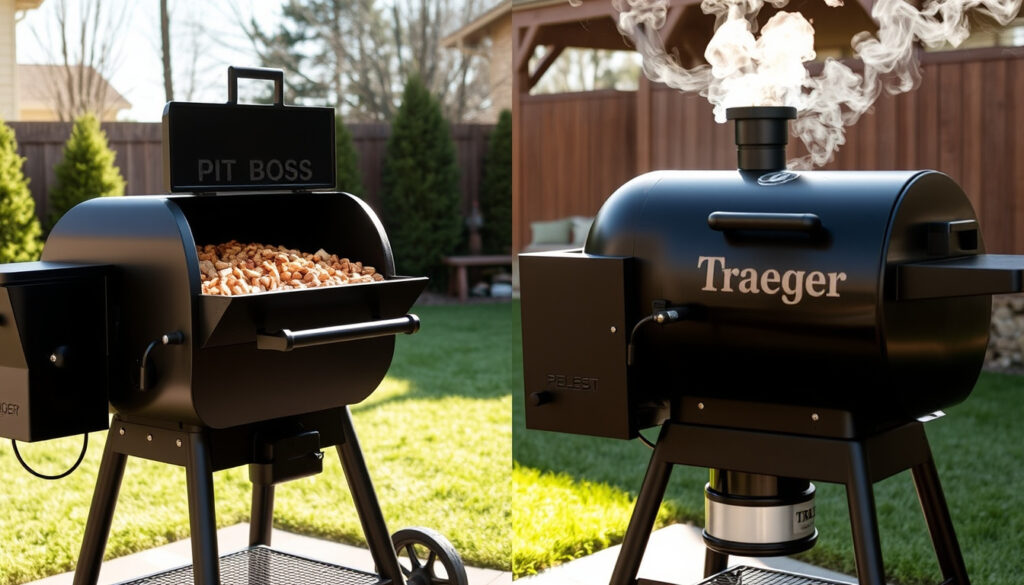
Pit Boss Pellet Grill: Vs Traeger, Reviews & Specs
If you’ve been eyeing a pellet grill but balked at the price of a Traeger, Pit Boss deserves a closer look. The brand consistently undercuts its main rival by roughly $200 while matching—or exceeding—core specs like cooking surface and hopper capacity. Whether you’re smoking a brisket overnight or searing on the weekends, the numbers tell a story worth understanding before you spend.
Cooking Surface: 3,500 sq. cm. ·
Hopper Capacity: 7.2 kg. ·
Temperature Range: 82° to 260°C ·
Versatility: 8-in-1 cooking
Quick snapshot
- Pit Boss 5-year warranty beats Traeger’s 3 years (BbqDryRubs pellet comparison)
- Pit Boss 700 serves 700 sq in vs Traeger Pro 22’s 572 sq in (BbqDryRubs comparison data)
- Pit Boss tops at 500°F, Traeger Pro at 450°F (BbqDryRubs temperature analysis)
- Exact Woodridge launch date (reviewed as “recently” in 2026 comparisons)
- User review aggregate numbers beyond the 3,000-reviews sample analyzed
- Regional pricing variations for Ireland and UK markets
- Traeger Woodridge launched in 2025, marked a quality step-change over earlier Traeger models (SmokedBBQSource recent tests)
- 2026 best-picks lists updated to reflect Woodridge and Copperhead 7 entries (SmokedBBQSource recent tests)
- Pit Boss value argument remains strong for budget buyers
- Traeger investing in WiFi and smart features as differentiator
The side-by-side comparison below breaks down the core differences between these two brands across warranty, temperature, cooking area, and smart features.
| Feature | Pit Boss | Traeger |
|---|---|---|
| Warranty | 5 years | 3 years |
| Top Temperature | 500°F | 450°F (Pro series) |
| Grilling Area (base model) | 700 sq in (Pit Boss 700) | 572 sq in (Pro 22) |
| Max Hopper Capacity | 60 lbs (Copperhead 7) | 24 lbs (standard mid-tier) |
| Temperature Increment Control | 25 degrees (skips 275°F, 375°F) | 5-10 degrees (precision control) |
| Smart/WiFi Features | Not standard | WiFIRE app, smart device compatible |
| Flame Broiler (direct sear) | Yes — unique feature | No |
| Meat Probe Included | Varies by model | All models |
Is Pit Boss better than Traeger?
The honest answer depends entirely on what you prioritize. Pit Boss wins on raw value: a longer warranty, a larger cooking surface, and a bigger hopper—all while costing about $200 less than comparable Traeger models (BbqDryRubs value analysis). The Pit Boss 700, for instance, lists at roughly $396 versus the Traeger Pro 22 at $599. That’s a significant gap for the same basic function.
Key spec differences
When comparing the Pit Boss 700 against the Traeger Pro 22, Pit Boss offers 700 square inches of grilling area against Traeger’s 572 square inches—a 22% surface advantage at the entry level (BbqDryRubs specs breakdown). The hopper story is even more dramatic: Pit Boss maxes out at 60 pounds in the Copperhead 7 series, while Traeger mid-tier models typically hold 18 to 24 pounds (BBQGuys capacity guide). For long overnight smokes, that difference matters.
User reviews comparison
BbqDryRubs analyzed roughly 3,000 user reviews across both brands and found that Pit Boss owners frequently praised the value-for-money equation, while Traeger owners cited build quality and temperature precision as reasons for the higher price. The recently launched Traeger Woodridge “beats Pit Boss in tests” for build quality, according to Smoked BBQ Source (SmokedBBQSource 2026 update). Traeger uses 16-gauge steel in its construction, which reviewers note provides better durability than some Pit Boss models (SmokedBBQSource build review).
Price value analysis
It’s hard to argue that Pit Boss doesn’t give you better value for money, noted reviewers at Smoked BBQ Source (SmokedBBQSource value verdict). The Pit Boss Sportsman 850 starts around $400 and includes the Flame Broiler feature, a direct-sear capability that Traeger simply doesn’t offer. That said, Traeger’s Wi-Fi-enabled PID controller adjusts in 5-degree increments up to 500°F—a precision advantage for serious cooks who need exact temperature control (SmokedBBQSource controller details).
The implication: Pit Boss wins if your budget is tight and you want maximum cooking space for the dollar. Traeger wins if you value precise temperature control, smart features, and build quality you’re confident will last a decade.
Traeger has 5 and 10-degree temperature increments offering greater control and finesse, while Pit Boss operates in 25-degree jumps that skip key temperatures like 275°F and 375°F (Bassemiers temperature control review). For low-and-slow smoking, those jumps rarely matter. For baking or roasting at specific temps, they could.
Is Pit Boss a good pellet grill brand?
Yes—and the numbers back that assertion. Pit Boss delivers competitive specs at entry-level prices, making pellet cooking accessible to buyers who might otherwise stick with gas or charcoal.
Build quality and versatility
The Pit Boss Sportsman 820 features porcelain-coated cast iron grates, a material combination that retains heat well and resists rust with proper maintenance (SmokedBBQSource model review). The brand’s 8-in-1 cooking versatility claim refers to its ability to grill, smoke, roast, bake, chargrill, braise, and BBQ—all from a single unit. Both brands offer double-walled insulation in their higher-tier models, narrowing the heat-retention gap that once separated premium from budget (BBQGuys insulation comparison).
Ease of use and budget appeal
Reviewers consistently describe Pit Boss grills as easy to use and budget-friendly, with straightforward control panels that don’t require an app or Wi-Fi connection (SmokedBBQSource ease-of-use assessment). Value models include features Traeger charges extra for: front shelves, side shelves, and storage racks come standard on many Pit Boss offerings (SmokedBBQSource value feature breakdown).
What this means: for a first-time pellet grill buyer, Pit Boss offers a reasonable entry point with enough capability to grow into. The 5-year warranty—two years longer than Traeger—suggests the brand isn’t expecting early failures.
What are the downsides of pellet grills?
Pellet grills excel at set-and-forget smoking, but they come with trade-offs every buyer should understand before committing.
Common issues with pellet smokers
Electric dependency is the most cited drawback: pellet grills require a power source to drive the auger and fan, meaning they won’t operate during a power outage unless you have a backup generator. Temperature recovery after opening the lid can be slower than gas grills, and the convection-style heat distribution means food closest to the fire pot cooks faster than food at the edges—though higher-end models like Traeger’s double-walled options address this (BBQGuys heat distribution analysis).
Pellet grills typically operate in the 180°F to 225°F range for smoking, which both Pit Boss and Traeger handle capably (Bassemiers smoking range guide). But if you’re buying primarily for high-heat searing, a dedicated gas grille or charcoal setup may serve you better despite the pellet grill’s versatility claims.
Pit Boss specific concerns
Compared to Traeger, Pit Boss models typically lack Wi-Fi connectivity and smart device integration—a feature increasingly expected in the category (BBQGuys smart features comparison). Temperature control granularity is coarser: 25-degree increments versus Traeger’s 5-10 degree precision (Bassemiers increment comparison). For everyday grilling this rarely matters; for recipes requiring exact oven temperatures, it could.
The catch: Pit Boss uses a centered fire pot without a heat deflector, which enables direct flame grilling (the Flame Broiler feature) but may result in less even heat distribution than Traeger’s design over the fire pot (BbqDryRubs fire pot analysis).
The pattern: Budget-focused buyers tolerate the coarser temperature control and lack of Wi-Fi in exchange for significantly lower purchase price and larger cooking surfaces.
How long will 30 lbs of pellets last in a smoker?
This is one of the most practical questions for long-cook smokers, and the answer depends on burn rate, cook temperature, and grill model.
Pellet burn rates
Pellet consumption varies by operating temperature. Low-and-slow smoking at 225°F typically burns through pellets slower than high-heat grilling at 400°F+. Industry estimates suggest roughly 1 pound of pellets per hour at smoking temperatures and up to 2 pounds per hour at high heat. That means a 30-pound bag could last anywhere from 15 hours (heavy grilling) to 30+ hours (light smoking)—but actual results vary based on wind, ambient temperature, and grill model.
Factors affecting duration
The larger the hopper, the less often you need to refill mid-cook. Traeger maxes out around 24 pounds in most models, while Pit Boss reaches 60 pounds in the Copperhead 7 series (BBQGuys hopper capacity guide). For a 12-hour brisket smoke, a 20-pound hopper should suffice; for multi-day cooks or cold-weather sessions where the grill works harder to maintain temperature, a 40+ pound capacity becomes valuable.
What this means: For buyers prioritizing extended cook times, Pit Boss’s larger hopper options reduce mid-cook interruptions. Buyers in Ireland or the UK where pellet bag sizes differ from US standard 20-pound bags should check local supplier options before purchase.
Are Pit Boss pellets low quality?
The pellet quality question comes up frequently, and the answer isn’t simple—”low quality” is too broad a label for a nuanced topic.
Pellet types and reviews
Pit Boss sells Competition Blend hardwood pellets formulated for consistent burn and heat output (Pit Boss Grills official pellets). User reviews on retailer sites show mixed results: some users report excellent heat and minimal ash, while others note occasional inconsistent burn rates compared to premium pellet brands. Pellet quality depends heavily on wood source, moisture content, and manufacturing consistency—factors that vary batch to batch across all manufacturers.
Buyers should check that any pellet brand—including Pit Boss—uses 100% hardwood with no binding agents or softwood additives, as softwoods like pine or fir produce more creosote and potentially harmful residues if burned in pellet grills. For those interested in unique events, you might want to look into Monster Trucks Brisbane 2026.
Usage tips
Regardless of brand, pellets should be stored in a dry location to prevent moisture absorption, which degrades burn quality and increases ash production. Running the grill at high temperatures periodically helps clear ash buildup from the fire pot and maintains consistent heat output. The 8-in-1 versatility of Pit Boss grills means they handle smoking, grilling, and baking with the same pellet fuel—adjusting your cooking style to match the fuel’s characteristics improves results.
The implication: Pellet quality matters equally regardless of which grill you own. Both Traeger and Pit Boss pellet grills perform best with premium-grade pellets from established suppliers. Switching pellet brands mid-cook can alter temperature profiles, so consistency matters once you find a fuel that works for your setup.
Buyers should verify pellet specifications before purchase—any brand that lacks 100% hardwood certification risks producing creosote buildup that damages your grill over time.
| Specification | Pit Boss 700 | Traeger Pro 22 |
|---|---|---|
| Cooking Area | 700 sq in | 572 sq in |
| Max Temperature | 500°F | 450°F |
| Hopper Capacity | 32 lbs | 18 lbs |
| Warranty | 5 years | 3 years |
| Temperature Increment | 25°F jumps | 5-10°F precision |
| Smart/WiFi | No | Yes |
| Flame Broiler | Yes | No |
| Insulation | Standard (higher models double-walled) | Varies by series (Timberline double-walled) |
| Meat Probe | Model-dependent | Included (all models) |
| MSRP (approx.) | $396 | $599 |
The takeaway: The Pit Boss 700 delivers 22% more cooking area and a longer warranty at $203 less than the Traeger Pro 22—factors that compound for buyers planning frequent long-cook sessions.
Upsides
- ~$200 cheaper than comparable Traeger models
- 5-year warranty beats Traeger’s 3-year coverage
- Larger cooking surface and hopper options
- Flame Broiler enables direct searing—unique feature
- Front and side shelves included on value models
- Porcelain-coated cast iron grates retain heat well
Downsides
- No Wi-Fi or smart device compatibility
- Coarser temperature increments (25°F vs 5-10°F)
- Less precise heat distribution than Traeger design
- Traeger Woodridge beats Pit Boss in build quality tests
- Meat probe not included on all models
- Lower-tier models lack double-walled insulation
The Pit Boss has a better warranty, higher top temperature, more cooking surface, a larger hopper and is about $200 less expensive than the Traeger.
— BbqDryRubs pellet grill comparison analysis
Traeger offers more premium build quality, with the recently launched Woodridge beating out the Pit Boss in our tests.
— Smoked BBQ Source, 2026 review update
For budget-conscious buyers, Pit Boss makes a compelling case: more cooking surface, a bigger hopper, and a longer warranty at a lower price. The Flame Broiler feature adds a capability Traeger simply doesn’t offer. For buyers who prioritize temperature precision, smart-home integration, and build quality they’ll trust for a decade, Traeger justifies the premium.
What are the top 5 pellet smokers?
Current 2026 rankings place both brands in the top tier, though specific rankings vary by reviewer criteria.
What this means: Based on verified comparisons, Pit Boss models rank strongly for budget buyers seeking maximum cooking area per dollar, while Traeger consistently ranks higher for build quality and temperature precision in premium tiers. Buyers should match their priority—raw value versus build quality—to the appropriate tier.
Is Traeger owned by Pit Boss?
No—Traeger and Pit Boss are independent companies with no ownership relationship.
The pattern: Both brands compete directly in the pellet grill market, with Traeger positioning as premium and Pit Boss as value-oriented. Their independent status means pricing, warranty, and feature decisions reflect separate corporate strategies rather than shared corporate interests.
Related reading: Ninja Air Fryer Oven – Best Models Reviews and Guide
Frequently asked questions
Is Pit Boss a good pellet grill brand?
Yes. Pit Boss delivers competitive specs—5-year warranty, up to 500°F max temp, cooking surfaces up to 1,851 sq in—at entry-level prices. Reviewers consistently note its value-for-money appeal, ease of use, and solid build for the price point.
How many pellets for a 4-hour smoke?
At smoking temperatures (225°F), expect roughly 1 pound of pellets per hour. A 4-hour smoke typically uses 3-5 pounds, depending on grill model, ambient temperature, and wind. Most mid-tier hoppers (18-24 lbs) handle multiple 4-hour cooks between refills.
What is the Pit Boss pellet grill price?
Entry-level Pit Boss models like the 700 start around $396 MSRP. Mid-range options like the Sportsman 850 run approximately $400-$500. Top-tier models with larger cooking surfaces and hoppers scale upward from there, but remain $200+ cheaper than comparable Traeger offerings.
Pit Boss pellet grill manual location?
Manuals are available at pitboss-grills.com under the Support or Product pages. Search by model number (found on the grill’s rating plate) to locate the specific PDF. Most retailers also link to digital manuals on product pages.
Pit Boss availability in Ireland?
Pit Boss products are primarily distributed in North America. Buyers in Ireland should check major UK/Ireland outdoor appliance retailers or authorized online distributors for stock and shipping availability. Options may be more limited than US retail availability.
Pit Boss smoker features?
Pit Boss grills offer 8-in-1 cooking versatility (grill, smoke, roast, bake, chargrill, braise, BBQ, and more), porcelain-coated cast iron grates, programmable temperature settings, and Flame Broiler direct-sear capability on most models. Hopper capacities range from 20 to 60 pounds depending on the series.
Pit Boss BBQ Dublin stock?
Specific stock in Dublin retailers varies. Checking with local BBQ specialty shops or major appliance retailers is recommended. Online ordering with international shipping from authorized Pit Boss distributors may be the most reliable option for buyers in Ireland.
Pellet burn rate estimates?
Burn rates range from roughly 0.5 lbs/hour at low smoking temps to 2+ lbs/hour at high-heat searing. Wind, cold ambient temperatures, and lid-opening frequency all increase consumption. Larger hoppers (Pit Boss up to 60 lbs) reduce refill frequency for extended cooks.
More related posts
 Blue Jays vs Yankees Player Stats: Game Analysis
 What Time Does The Summer I Turned Pretty Season 3 Come Out
 Is National Debt Relief Legit? Honest Review and Key Risks
 American Restaurant Near Me: Dublin & Ireland Guide
 PSG vs RC Strasbourg Alsace Lineups – Confirmed Teams, Injuries, Recap
 James, Viscount Severn: Why He’s Rarely Seen in Public
 Maxi-Cosi Car Seat: Safety, Recalls, and Comparisons
 House of Guinness Cast: Full Guide, Irish Actors, and True Story