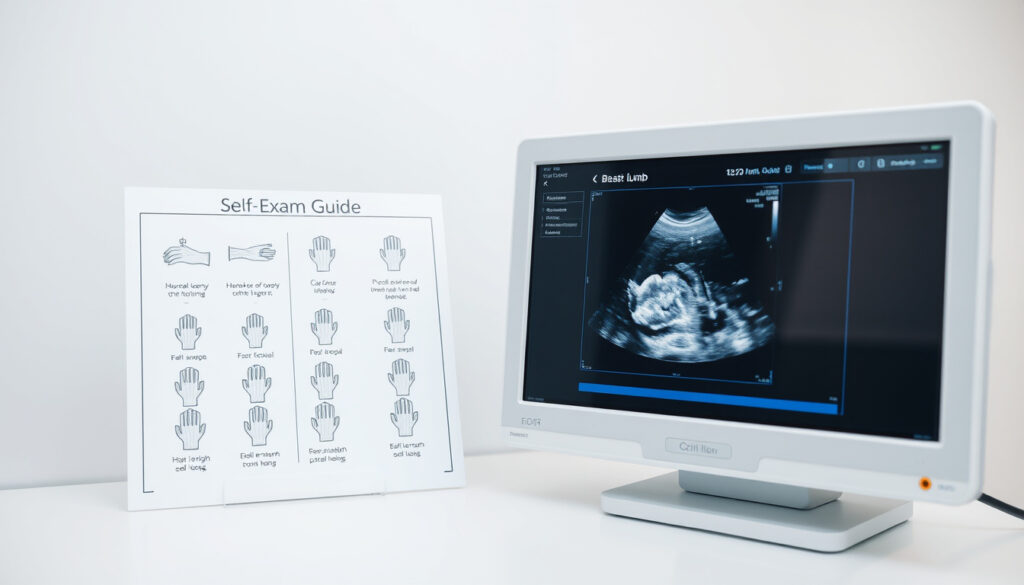
Pictures of Breast Cancer Lumps: Ultrasound & Self-Exam Guide
Finding a lump in your breast can feel terrifying — even if you’ve heard that most of them turn out to be harmless. The truth sits somewhere in between: about 80% of breast lumps are benign, yet a new mass remains the most common sign of breast cancer, according to the American Cancer Society. This guide walks through what cancer lumps actually look like on ultrasound and during self-exam, so you know what to look for and when to get it checked.
Percentage of breast lumps that are not cancerous: 80% · Common source of benign lumps: Cysts · Recommended action for lumps: See a doctor · Early detection benefit: Saves lives
Quick snapshot
- 80% of lumps are benign (Healthgrades)
- Cancer lumps often painless and immovable (Healthline)
- Visuals alone can’t diagnose — biopsy is required (WebMD)
- Some lumps appear soft, round, and tender despite being malignant (Medical News Today)
- Fat necrosis may take 1.5 years to show calcified walls on ultrasound (YouTube)
- Early-stage cancer often asymptomatic; lumps may grow years before palpable (Capital Health Cancer)
- If you find a lump, doctors may order ultrasound, mammogram, or biopsy (Medical News Today)
- Targeted ultrasound evaluates specific lumps or mammography findings (DenseBreast-info)
Four categories of breast lump characteristics — from completely benign to potentially malignant — based on physical exam and imaging findings.
| Category | Typical Characteristics | Medical Context |
|---|---|---|
| Benign Lump | Soft, movable, often painful | May include cysts, fibroadenomas |
| Cancerous Lump | Hard, irregular, fixed in place | May cause skin dimpling or nipple inversion |
| Early Stage | Small size, no visible skin change, usually painless | Tumor under 2 cm, no lymph node spread |
| Advanced Signs | Dimpling like orange peel, redness, inverted nipples | May indicate inflammatory or invasive cancer |
What does a breast cancer lump look like?
Breast cancer lumps typically feel hard with uneven edges and tend to be painless — though some malignant masses can be soft, round, and tender, according to Medical News Today. On ultrasound, these masses appear hypoechoic (darker than surrounding tissue), with irregular shapes and angular or indistinct borders rather than smooth edges. Research from the NIH PMC database documents specific ultrasound findings that radiologists use to assess malignancy risk.
Early stage appearance
Early-stage breast cancer lumps are typically under 2 centimeters and may not produce visible skin changes. Most malignant tumors appear as single, hard lumps or thickenings, with about 50% occurring in the upper outer quadrant extending toward the armpit, according to Stony Brook Cancer Center. At this stage, the lump is usually painless and may go unnoticed without regular self-examination.
Skin changes
As cancer progresses, skin changes may appear. Cancerous lumps can cause dimpled skin that resembles an orange peel texture, inverted nipples, or a rash — typically on one breast only, according to Healthline. Inflammatory breast cancer, a rarer aggressive type, shows no distinct lump but produces red, swollen, pitted skin resembling an orange peel, per WebMD.
Size variations
Breast cancer lumps vary from roughly pea-sized to larger masses. The average size at detection depends on factors including tumor growth rate and whether regular screening is performed. Early detection through mammography can find tumors before they become palpable, according to Capital Health Cancer.
The implication: a hard, painless, immovable lump with irregular edges warrants medical evaluation — but no visual or physical finding alone can confirm cancer; only biopsy provides certainty.
How do you tell the difference between a cancer lump and a normal lump?
The most reliable way to distinguish a cancerous lump from a benign one combines physical examination findings with imaging. On ultrasound, cysts — the most common breast lumps — appear echolucent, round or oval with sharp margins and posterior enhancement, per The Radiology Assistant. Cancerous masses, by contrast, show hypoechoic patterns with irregular, uncircumscribed borders.
Texture and mobility
- Cancer lumps: hard with uneven edges, typically immovable within surrounding tissue
- Benign lumps: softer and more movable, often tender or painful
Pain levels
Cancerous lumps are often painless, though some can be tender. Benign cysts frequently cause discomfort that fluctuates with the menstrual cycle, according to research published in the NIH PMC database.
Location factors
Approximately 50% of malignant lumps occur in the upper outer quadrant of the breast, with some extending toward the armpit, per Stony Brook Cancer Center. Cysts are most common in women aged 35–50 years, appearing as well-defined, anechoic structures on ultrasound, per NIH PMC research.
Texture and mobility give useful clues: a hard, fixed lump deserves prompt imaging. Yet the only sure way to confirm whether a lump is cancerous is biopsy, as WebMD emphasizes.
The pattern: benign lumps tend to be soft, round, and mobile; cancer lumps tend to be hard, irregular, and fixed. But exceptions exist — making imaging essential rather than self-examination alone.
What does Stage 1 breast cancer look like?
Stage 1 breast cancer represents an early, localized form of the disease. The tumor is typically under 2 centimeters and has not spread to lymph nodes. At this stage, many patients have no obvious symptoms, which is why screening mammography plays a critical role in early detection, per Capital Health Cancer.
Small lump size
Stage 1 tumors measure less than 2 centimeters — roughly the size of a pea or a marble. These small sizes often make them impossible to detect through physical examination alone, which is why imaging methods become essential for early diagnosis.
No visible skin changes
Unlike advanced cancers that cause dimpling, redness, or nipple changes, Stage 1 typically presents as a small, painless mass without external visible signs. The lump may be discovered incidentally during a clinical breast exam or screening mammogram.
Ultrasound views
On ultrasound, early-stage malignant masses appear hypoechoic with irregular borders. Key indicators radiologists look for include spiculation (spike-like projections from the tumor edge) and taller-than-wide shape, which indicates higher malignancy risk, according to Radiopaedia.
Sonographic spiculation carries approximately 90% positive predictive value for malignancy in breast lesions, while taller-than-wide shape shows 81.2% PPV, per research from the NIH PMC database. These imaging markers help radiologists flag suspicious lesions before biopsy.
What this means: Stage 1 breast cancer is most treatable precisely because it has not spread. The challenge is that it often has no visible or palpable signs — making regular screening essential for women at average risk and even more important for those with dense breast tissue.
How to tell if a lump could be cancerous?
Identifying potentially cancerous lumps involves combining self-examination awareness with understanding red flags that warrant professional evaluation. While self-exams alone have not been proven to detect cancer before symptoms appear, they help women become familiar with their breast tissue and notice changes, per Healthline.
Self-exam steps
- Stand before a mirror and visually inspect both breasts for symmetry changes, skin dimpling, or nipple abnormalities
- Raise one arm behind your head and use the pads of your fingers on the opposite hand to feel the breast in a circular motion from outside toward the center
- Check the entire breast area, including the upper outer quadrant extending toward the armpit
- Note the texture, mobility, and any fixed areas you detect
Red flags
- New lump or thickening that feels distinct from surrounding tissue
- Hard, immovable mass with irregular edges
- Nipple changes including inversion, discharge, or scaling
- Skin dimpling resembling orange peel texture
When to seek help
The “2-week rule” refers to guidelines requiring that anyone with a breast symptom receive a specialist appointment within two weeks of referral. If you discover a new lump or any concerning changes, schedule a clinical evaluation promptly, per Medical News Today.
Not all cancer lumps feel hard or irregular — some are soft, round, and tender, according to Medical News Today. This means any new, persistent lump deserves professional evaluation regardless of how it feels.
The implication: self-examination raises awareness but cannot replace clinical assessment. Diagnostic tests after a self-exam finding include mammogram, ultrasound, MRI, and biopsy depending on initial imaging results, per Medical News Today.
What are the top signs of breast cancer?
The CDC identifies the top three signs of breast cancer as: a new lump or thickening, skin changes, and nipple abnormalities. A new mass or lump in breast tissue remains the most common sign of breast cancer, according to the American Cancer Society, per Healthgrades.
Lumps in armpit
Breast cancer can spread to lymph nodes under the arm before producing a breast lump. Enlarged, hard, or fixed lymph nodes in the armpit area may indicate metastatic involvement and warrant urgent evaluation.
Changes in men
While rare, men can develop breast cancer — typically presenting as a painless lump beneath the nipple area. Male breast cancer accounts for less than 1% of all breast cancer cases but carries similar warning signs including lumps, skin changes, and nipple discharge.
Mammogram pictures
Mammography can reveal calcifications, masses, and architectural distortions that may not be palpable. On mammogram, cancer often appears as a spiculated mass with irregular borders, while benign lesions tend toward smooth, well-defined edges, per Capital Health Cancer.
Ultrasound excels in dense breasts where mammography may miss small cancers, according to research published in the NIH PMC database. Women with dense breast tissue should discuss supplemental screening options with their healthcare provider.
The implication: the first red flag of breast cancer is most often a new lump — but not always a cancer one. About 80% of breast lumps turn out to be benign, per Healthgrades. The body’s response to a cancer lump may include tenderness, swelling, or discomfort in the affected area.
Early-stage cancers often grow silently for years before becoming detectable through palpation or imaging. For patients who discover a new lump, the path forward is clear: document what you found, when you noticed it, and schedule a clinical evaluation within two weeks. Targeted ultrasound evaluates specific lumps or mammography abnormalities, per DenseBreast-info. If imaging suggests concern, biopsy provides the definitive answer — because no imaging finding alone can rule in or rule out cancer, as WebMD notes.
Ultrasound imaging: benign vs. malignant features
Ultrasound provides detailed information about breast tissue composition and mass characteristics. Radiologists use the BI-RADS classification system to standardize lesion assessment and malignancy risk communication, per NIH PMC research.
Two key features distinguish malignant from benign masses on ultrasound, backed by predictive values from large studies:
| Feature | PPV/NPV | Interpretation |
|---|---|---|
| Sonographic spiculation | ~90% PPV | Highly suggestive of malignancy per Radiopaedia |
| Taller-than-wide shape | 81.2% PPV | Strong indicator per NIH PMC |
| Angular margins | 67.5% PPV | Moderate malignancy risk per NIH PMC |
| Hypoechogenicity | 60.1% PPV | Moderate risk indicator per NIH PMC |
| Ellipsoid shape | 99% NPV | Highly reassuring for benignancy per Radiopaedia |
| Well-circumscribed hyperechoic tissue | ~100% NPV | Almost certainly benign per Radiopaedia |
The trade-off: these predictive values apply to populations and individual lesions may behave differently. Radiologists combine multiple features rather than relying on any single indicator.
Microvessels in a malignant breast cancer mass look curved and jumbled together whereas benign breast tissue microvessels appear straight and separated on 3D ultrasound.
— Imaging expert, YouTube medical imaging resource
A new mass or lump in breast tissue is the most common sign of breast cancer.
— Medical News Today
The only sure way to know a lump is cancer is to do a biopsy.
— WebMD
Fat necrosis — a benign condition involving fatty tissue breakdown — can mimic malignancy on ultrasound and may take up to 1.5 years to develop characteristic calcified walls, per YouTube ultrasound education. This benign mimic requires follow-up imaging to track changes.
For women who find a breast lump, the decision is straightforward: seek clinical evaluation. The combination of physical examination, imaging (typically starting with ultrasound or mammogram), and biopsy when indicated provides the most accurate diagnosis. Early detection meaningfully improves outcomes — making prompt evaluation of any new finding the most important step you can take.
Related reading: Pre-Heart Attack Symptoms in Women · How to Improve Gut Health
Alongside ultrasound imagery in this guide, real pictures of breast cancer lumps provide essential real-world visuals for spotting irregular, firm cancerous growths during self-exams.
Frequently asked questions
Does a lump always mean cancer?
No — approximately 80% of breast lumps are benign, according to Healthgrades. Common benign causes include cysts, fibroadenomas, and fat necrosis. However, any new lump warrants professional evaluation.
What is the average size of a breast cancer lump?
Breast cancer lumps range from pea-sized to larger masses detectable by touch or imaging. Early-stage tumors are typically under 2 centimeters. Detection size often depends on whether regular screening mammography is performed.
What is the first red flag of breast cancer?
The American Cancer Society identifies a new lump or mass as the most common first sign of breast cancer, per Healthgrades. This new mass may be painless, hard, and immovable — though some cancerous lumps are soft or tender.
How does your body feel when you have breast cancer?
Early-stage breast cancer often causes no symptoms. As cancer progresses, the body may respond with tenderness, swelling, or discomfort in the affected area. Advanced signs include skin changes resembling orange peel, nipple inversion, or unexplained redness, per Healthline.
What is the 2-week rule for breast lumps?
The “2-week rule” refers to referral guidelines ensuring that anyone with breast symptoms sees a specialist within two weeks. If you discover a new lump, skin changes, or nipple abnormalities, request a clinical evaluation promptly.
Can men get breast cancer lumps?
Yes, though male breast cancer is rare — accounting for less than 1% of cases. Warning signs mirror those in women: new lumps, skin changes, nipple discharge, or discomfort. Men should seek evaluation for persistent breast changes.
What do armpit breast cancer lumps look like?
Approximately 50% of malignant breast lumps occur in the upper outer quadrant, with some extending toward the armpit area, per Stony Brook Cancer Center. Enlarged, hard, or fixed lymph nodes in the armpit may indicate cancer spread and require urgent evaluation.
More related posts
 JLo and Ben Affleck: Split Timeline, Reasons & Latest News
 Is Dolly Parton Sick? 2025 Health Truths & Updates
 How to Clear Cookies on iPhone: Step-by-Step Guide
 iPhone 17 Release Date: When Does It Come Out in 2025?
 Federal Judge Orders Trump to Admit 12,000 Refugees
 2024 Acura TLX Type S: Price, Specs, 0-60 & Worth Buying?
 How to Play Mahjong: Step-by-Step Rules for Beginners
 How Long Does It Take to Walk a Mile? Average Times by Age