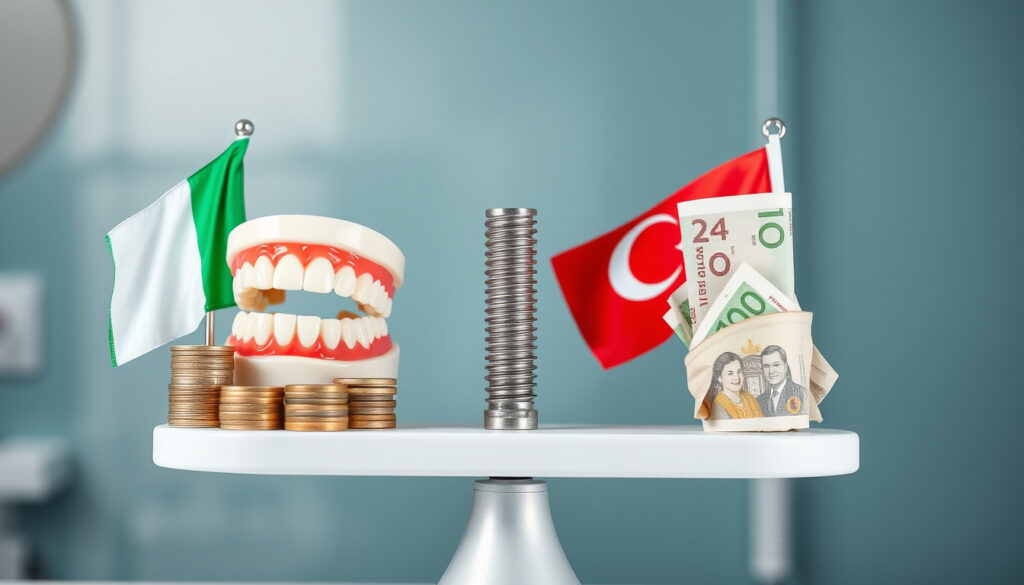
Full Mouth Dental Implants: Ireland vs Turkey Costs
Losing all your teeth, or facing the possibility, lands differently once you start looking into real solutions. It’s not just a dental question — it becomes a conversation about money, quality of life, and where you’re willing to go for treatment. Full mouth dental implants sit at the center of that conversation. In Ireland, a full set typically costs €20,000–€30,000. In Turkey, the same procedure runs €5,000–€10,000 — a difference that has tens of thousands of Irish patients weighing their options. This guide breaks down the real costs, how All-on-4 and All-on-6 differ, and what that price gap actually means in practice.
Implants per arch in All-on-4: 4 · Implants per arch in All-on-6: 6 · Full mouth replacement option: permanent fixed bridges · Common providers in Ireland: Dublin clinics
Quick snapshot
- All-on-4 uses 4 implants per arch (Medical Dental Turkey)
- All-on-6 uses 6 implants per arch (Medical Dental Turkey)
- Ireland All-on-4 averages €11,833 per arch (Excelentis)
- No verified All-on-6 pricing specific to Irish clinics
- Exact cost breakdowns for bone grafting or sinus lifts not published
- 2026 Turkey All-on-4 pricing published at $2,500–$6,500 per arch (Turkey Luxury Clinics)
- Ireland 2025 price list likely carries into 2026 (Turkey Luxury Clinics)
- New denture types and digital-guided implant placement expanding (Turkey Luxury Clinics)
- Read on for Ireland-specific pricing and pros/cons
- Compare All-on-4 vs All-on-6 for your bone density
- Understand what Turkey packages actually include
These key figures establish the baseline for comparing treatment options across countries.
| Field | Value |
|---|---|
| Primary use | Full arch tooth replacement |
| Key Irish providers | TruSmile, Seapoint Clinic |
| Implant placement | Two front, two back for All-on-4 |
| Alternative to | Removable dentures |
| All-on-4 Ireland range | €9,500–€14,000 per arch |
| All-on-6 Turkey range | €3,500–€8,000 per arch |
| Savings potential (Turkey vs Ireland) | Up to 70% |
How much does a full mouth of implants usually cost?
Full mouth dental implant costs shift dramatically depending on where you get treated. In the United States, All-on-4 procedures run $19,000–$30,000 per arch — and that’s before factoring in consultations, imaging, or follow-up visits. In the UK, prices land between £10,500 and £13,500 for both jaws. Those figures put the global average well out of reach for many patients.
Factors affecting cost
Several variables drive the final bill. Implant brand matters — premium manufacturers like Straumann or Nobel Biocare command higher prices than budget alternatives. Prosthesis type (acrylic vs. zirconia) adds another layer. And if bone density is low, bone grafting or sinus lifts push costs upward. In Turkey, clinics often bundle these extras into all-inclusive packages covering hotel, airport transfers, and medications — a model that keeps headline prices low even when individual line items are comparable.
Average ranges by location
Cross-border cost comparisons reveal a stark pattern: Turkey undercuts Western clinics dramatically while using the same premium implant brands.
| Location | All-on-4 per arch | All-on-6 per arch |
|---|---|---|
| United States | $19,000–$30,000 | $24,000–$38,000 |
| United Kingdom | £12,000–£18,000 | £14,000–£18,000 |
| Ireland | €9,500–€14,000 | Not publicly verified |
| Turkey | €2,800–$6,500 | €3,500–€8,000 |
Turkey undercuts Ireland by roughly 70% for comparable procedures, according to Laviva Clinics (dental tourism clinic tracking cost differentials). What that gap doesn’t show is the travel cost, the language barrier during aftercare, and the fact that follow-up visits happen locally after surgery abroad.
Patients booking in Turkey typically save €14,000–€20,000 on the procedure itself. But add return flights, accommodation for two trips, and potential corrective work back home, and the real saving narrows considerably.
How much is a full set of dental implants in Ireland?
For Irish patients, All-on-4 pricing starts from €9,500 and reaches €14,000 per arch, with an average landing around €11,833 according to Excelentis (dental cost aggregator tracking Irish clinic pricing). Full mouth treatment — both arches — typically runs €20,000–€30,000. That puts Ireland near the middle of the European pricing band, below the UK but well above Turkey.
All-on-4 costs in Dublin
Dublin clinics like 3Dental anchor the lower end of the Irish range at €9,500 per arch. Galway-based practices push toward €14,000, reflecting higher operating costs in that city. Rural clinics sometimes undercut Dublin on materials but add travel inconvenience for patients requiring multiple visits.
All-on-6 pricing
Irish-specific All-on-6 data is thin. No verified clinic pages publish clear per-arch pricing for the six-implant system in Ireland. Based on regional comparisons from Maltepe Dental Clinic (Turkey-based clinic publishing international comparisons), All-on-6 typically costs 20–30% more than All-on-4. Applying that premium to Irish All-on-4 rates suggests a full arch range of roughly €12,000–€18,000 — though patients should request itemised quotes before committing.
Irish patients face a €20,000–€30,000 bill for full mouth implants at home. The closest verified alternative — Turkey — quotes €8,000–€10,000 for both arches in all-inclusive packages.
Are full mouth dental implants a good idea?
For patients missing all or most of their teeth, full mouth implants represent the closest functional match to natural dentition. Unlike dentures, they don’t shift, click, or require removal. Unlike bridges, they don’t rely on adjacent healthy teeth for support. The clinical case for implants is strong when bone density supports the procedure.
Benefits for full arch replacement
All-on-4 and All-on-6 systems both anchor a fixed prosthetic arch directly to the jawbone. Medical Dental Turkey (clinic guide) notes that this setup preserves bone density, which otherwise deteriorates after tooth loss. Patients report near-normal chewing ability, improved speech confidence, and elimination of the daily maintenance routine required for dentures.
Who qualifies
All-on-4 is designed for patients with reduced bone density — the posterior implants are angled to avoid sinus cavities and often eliminate the need for bone grafting, according to Dose Group (Turkey clinic with implant placement guides). All-on-6 requires higher bone density to accommodate two additional implant sites but offers greater stability for patients with strong bite force or those who grind their teeth.
All-on-4 suits older patients with bone loss, while All-on-6 targets younger patients with healthy jawbone structure seeking a lifetime solution — the extra implants justify the investment only when bone quality supports them.
What is the downside of full mouth implants?
Every surgical procedure carries risk, and full mouth implants are no exception. The downsides cluster around cost, recovery, and long-term maintenance — and they’re worth understanding before you commit.
Surgical risks
Infection, nerve damage, and implant failure occur in a small percentage of cases. Bone grafting complications, sinus perforation (upper jaw), and prolonged bleeding are documented risks. Maltepe Dental Clinic (Turkey clinic with procedure documentation) notes that failure rates correlate most strongly with smoking, uncontrolled diabetes, and poor oral hygiene after surgery — not the country where the procedure occurs.
Maintenance needs
Implants require lifetime maintenance. Unlike natural teeth, they don’t have a periodontal ligament, so bone loss can occur silently around implants if cleaning is neglected. All-on-6 is more difficult to clean due to the additional implant sites, as noted by Medical Dental Turkey. Annual professional cleaning and careful home hygiene are non-negotiable. Repair or replacement costs for chipped prosthetics or failed abutments add to the lifetime cost.
All-on-4 implants last 15+ years with proper care, according to BGZ Dental Turkey (Turkey clinic comparison guide) — but that estimate assumes consistent aftercare, which becomes complicated when follow-up happens in a different country.
Why are dental implants so cheap in Turkey?
The price gap between Turkey and Western Europe isn’t a quality issue — it’s an economics issue. Turkish dental clinics operate in a lower-cost environment that applies to rent, staff wages, materials, and lab work. That structural advantage gets passed directly to patients.
London vs Turkey factors
A dental lab in Istanbul pays a fraction of what a London lab charges for the same zirconia prosthetic. A specialist oral surgeon in Antalya earns considerably less than their UK counterpart — but training standards are often comparable, with many Turkish implantologists holding certifications from European or American boards. Karat Dent (Turkey clinic with 2026 pricing) highlights that clinics serving international patients maintain internationally accredited sterilisation protocols and use the same implant brands — Straumann, Nobel Biocare — found in Dublin or London.
Ireland alternatives
Irish patients who want domestic care face the full cost burden. Some opt for a hybrid approach: initial consultation and bone assessment in Ireland, then surgery in Turkey. This splits the aftercare — critical for catching early signs of infection or implant mobility — between local and foreign providers. It’s a workable compromise, but it requires careful coordination and clear agreements about who handles complications.
The cost driver breakdown shows Turkey maintains lower prices across every category while using identical premium implant brands.
| Cost driver | Ireland | Turkey |
|---|---|---|
| Surgeon fees | High | Lower |
| Lab work | High | Lower |
| Clinic overhead | High | Lower |
| Implant brands used | Straumann, Nobel Biocare | Same premium brands |
| All-inclusive packages | Rare | Common |
| Travel costs added | None | Flights + accommodation |
Turkey’s cost advantage evaporates if a patient needs corrective surgery back home. One revision procedure in Ireland can cost more than the original Turkey treatment. Verify the clinic’s warranty policy and confirm your local dentist will handle follow-up care before booking.
All-on-4 vs All-on-6 comparison
Choosing between the two systems depends on bone health, budget, and how hard you bite. Here’s how they stack up across the dimensions that matter most.
The comparison table below lays out the trade-offs between fewer implants at lower cost versus maximum stability and force distribution.
| Criteria | All-on-4 | All-on-6 |
|---|---|---|
| Implants per arch | 4 | 6 |
| Bone density required | Low to moderate | Moderate to high |
| Typical cost (Ireland) | €9,500–€14,000 | Estimated €12,000–€18,000 |
| Typical cost (Turkey) | €2,800–$6,500 | €3,500–€8,000 |
| Treatment duration | Shorter | Longer |
| Stability for hard foods | Good | Superior |
| Longevity estimate | 15+ years | Longer (medium confidence) |
| Cleaning difficulty | Easier | More complex |
| Best suited for | Older patients, bone loss cases | Younger patients, strong bite force |
The implication: All-on-4 is the pragmatic choice for most patients. Fewer implants mean lower cost, less invasive surgery, and faster recovery. All-on-6 makes sense when bone density is strong, budget allows, and the patient wants maximum long-term stability.
Full mouth dental implants: pros and cons
Upsides
- Permanent fixed teeth that don’t shift or require adhesive
- Near-natural chewing ability and speech
- Preserves jawbone density after tooth loss
- Eliminates the ongoing cost of denture replacements and adhesives
- Turkey option offers 70% savings on procedure cost
- All-on-4 often avoids bone grafting in bone-loss patients
Downsides
- High upfront cost: €20,000–€30,000 in Ireland
- Surgical risks including infection, nerve damage, implant failure
- Requires lifetime maintenance and professional cleaning
- All-on-6 harder to clean around extra implant sites
- Travel for Turkey treatment adds cost and coordination effort
- Follow-up complications harder to manage across borders
“All-on-4 dental implants are more suitable for patients with low bone density due to fewer implants.”
— Medical Dental Turkey (clinic guide)
“In a six-implant system, the force is more vertical and distributed across the entire dental arch.”
— Karat Dent (clinic expert)
“All-on-4 in Turkey offer savings of 70–80% compared to the US.”
— Turkey Luxury Clinics (clinic blog)
Summary
Full mouth dental implants are a proven solution for total tooth loss, with All-on-4 and All-on-6 representing the two main pathways. In Ireland, costs run €20,000–€30,000 for both arches — a significant commitment that places treatment out of reach for some patients. Turkey delivers the same clinical outcome at €5,000–€10,000, but travel logistics, aftercare coordination, and warranty coverage require careful management. All-on-4 suits patients with bone loss and tighter budgets; All-on-6 rewards those with healthy jawbone and a priority on maximum stability.
For Irish patients weighing their options, the choice isn’t simply “home or abroad” — it’s about what happens if something goes wrong six months after surgery. Confirm your clinic’s warranty terms, arrange local aftercare in advance, and get a written cost breakdown before signing anything.
Related reading: Pre Heart Attack Symptoms in Women · Is Fasting Good for You
youtube.com, cliniccenter.co.uk, dentalexcellenceturkey.com, 3dental.ie
Patients weighing Ireland’s high costs against Turkey’s savings should review a procedure and recovery guide to grasp the full process, risks, and expected outcomes.
Frequently asked questions
What are All-on-4 dental implants?
All-on-4 is a full arch restoration technique that uses four strategically placed implants to support a complete prosthetic arch. Two implants sit vertically at the front, two are angled at the back to maximise contact with available bone and avoid anatomical structures like sinus cavities.
What is the difference between All-on-4 and All-on-6?
All-on-4 uses four implants per arch; All-on-6 uses six. The additional two implants in All-on-6 provide greater stability and better force distribution, but they require higher bone density to place. All-on-4 is more affordable and better suited for patients with bone loss.
How long do full mouth dental implants last?
All-on-4 implants last 15+ years with proper care, according to BGZ Dental Turkey. The prosthetic arch may need replacement after 10–15 years due to wear, but the implants themselves can last a lifetime.
Who is eligible for full mouth implants?
Most adults missing all or most teeth in one or both arches are candidates. Key requirements include adequate bone density (or willingness to undergo grafting), controlled medical conditions like diabetes, and non-smoking status or commitment to cessation. A clinical assessment with imaging determines eligibility.
What is the recovery time for full mouth implants?
Initial healing takes 2–4 months for the implants to integrate with bone (osseointegration). Patients typically receive a temporary prosthetic within days of surgery and transition to the final arch after healing. Full recovery and normal eating habits resume within 4–6 months.
Are full mouth implants covered by insurance?
In Ireland and most Western countries, basic dental insurance does not cover elective implant procedures. Some supplemental plans offer partial coverage. Medical necessity may apply if implants are required due to accident or disease — but routine full mouth replacement typically falls outside standard coverage.
How do implants compare to dentures?
Fixed implants function like natural teeth — no removal, no adhesive, no slippage. They preserve jawbone density, which dentures do not. Dentures cost less upfront but require ongoing replacement, adhesive purchases, and can accelerate bone loss. Implants carry a higher initial cost but lower lifetime maintenance burden.
More related posts
 Brooklyn Nets vs Lakers Match Player Stats: 2026 Scores & Leaders
 How to Pair AirPods to Android: Complete Step-by-Step Guide
 When Is Trump’s Birthday? Date, Age & Celebration Details
 Duplex for Sale Near Me: Prices, Rules & Buying Guide in Ireland
 How to Smoke a Brisket: Temperature, Time & the 3-2-1 Rule
 Cast of HIM 2025: Marlon Wayans, Plot, and Why It’s Polarizing
 From Dusk Till Dawn Cast: Full List, Ages, Trivia (1996)
 Is Raikou of the Dragons Real? The Truth Behind the Meme