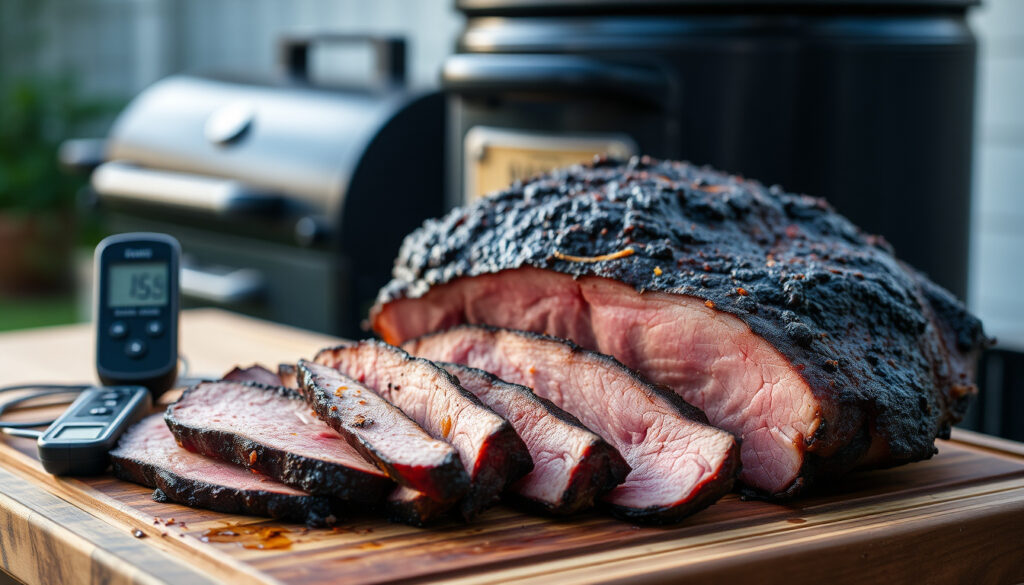
How to Smoke a Brisket: Temperature, Time & the 3-2-1 Rule
Anyone who’s spent a weekend watching a smoker knows that brisket can be one of the most rewarding — and most frustrating — things to cook. The meat is forgiving if you understand its rhythms, and punishing if you don’t.
Best smoking temperature: 225°F (107°C) ·
Average cooking time per pound: 60 to 90 minutes ·
Stall temperature range: 150°F to 170°F (65-77°C) ·
Wrap temperature target: 165°F (74°C) ·
Finish temperature target: 200-205°F (93-96°C) ·
Recommended resting time: 1 to 2 hours
Quick snapshot
- Choose a whole packer brisket, 12-14 pounds, for the best results (Snake River Farms (ranch-to-table meat producer))
- Look for Prime or Choice grade — Prime has superior marbling and is more forgiving for beginners (Snake River Farms (ranch-to-table meat producer))
- Aim for 12-14 pounds to give you enough time to manage the stall and rest (Snake River Farms (ranch-to-table meat producer))
- Leave a 1/4 inch fat cap for optimal smoke penetration and bark formation (Snake River Farms (ranch-to-table meat producer))
- Remove the hard, waxy fat from the point — it won’t render and creates a greasy spot (Snake River Farms (ranch-to-table meat producer))
- Shape it for even cooking thickness by squaring the edges slightly (Snake River Farms (ranch-to-table meat producer))
- Apply 16 mesh coarse black pepper and kosher salt generously — the classic Texas “Dalmatian” rub
- Optional: garlic powder or a commercial rub, but keep it simple for your first cook
- Season at least 1 hour before smoking, or overnight in the refrigerator for deeper flavor
- Set smoker to 225-250°F using oak or hickory wood (Traeger (smoker manufacturer guide))
- Smoke fat side up until internal temp hits 165°F — the ideal wrap temperature (Traeger (smoker manufacturer guide))
- Wrap in butcher paper or foil and return to smoker until 200-205°F internal temperature (Traeger (smoker manufacturer guide))
| Parameter | Value | Source |
|---|---|---|
| Ideal Cut | Whole Packer Brisket (12-14 lbs) | Snake River Farms (ranch-to-table meat producer) |
| Smoking Temperature | 225°F – 250°F | Snake River Farms (ranch-to-table meat producer) |
| Recommended Woods | Oak, Hickory, Pecan | Traeger (smoker manufacturer guide) |
| Stall Temperature | 150°F – 170°F | Snake River Farms (ranch-to-table meat producer) |
| Wrap Temperature | Around 165°F | Traeger (smoker manufacturer guide) |
| Final Temperature | 200°F – 205°F | Snake River Farms (ranch-to-table meat producer) |
| Essential Rest Time | 1 – 2 hours | Snake River Farms (ranch-to-table meat producer) |
How to smoke a brisket for beginners?
How to choose the right brisket?
- Select a whole packer brisket (12-14 lbs) with a good fat cap (Snake River Farms (ranch-to-table meat producer))
- Look for Prime or Choice grade — Prime has superior marbling and is more forgiving for beginners
- The packer includes both the flat (leaner) and the point (fattier, more flavorful) cut, which gives you two textures in one cook
Fat cap quality matters more than many beginners realize. A brisket with a thick, even layer of fat on the cap will baste the meat as it renders, keeping the lean flat from turning into jerky. Aaron Franklin of Franklin Barbecue has stated that a simple kosher salt and coarse black pepper rub is all you need for prime brisket (Houstonia Magazine (Texas culture and food publication)).
The implication: grade selection is a trade-off between cost and margin of error. Prime is easier to nail on your first try.
How do I trim and season a brisket?
- Trim the fat cap to 1/4 inch thickness — too much fat blocks smoke penetration and bark formation (Snake River Farms (ranch-to-table meat producer))
- Remove the hard, waxy fat from the point — it won’t render and creates a greasy spot
- Shape the brisket for even cooking thickness by squaring the edges slightly
- Apply a coarse salt and black pepper rub generously — the classic Texas “Dalmatian” rub is 16 mesh black pepper and kosher salt in roughly equal parts
Meathead Goldwyn of AmazingRibs.com has argued that cooking solely by time is a critical beginner mistake — seasoning and trimming should be judged by sight and feel, not the clock (Snake River Farms (ranch-to-table meat producer)).
The trade-off: more fat left on means more moisture but less bark. Beginners benefit from a slightly thicker fat cap for margin, but competition cooks trim closer for a cleaner bite.
How to smoke a brisket on a pellet grill?
- Smoking at 225-250°F until internal temp of 165°F is the standard window (Traeger (smoker manufacturer guide))
- Pellet grills deliver steady temperature, making them ideal for first-time smokers
- Use oak or hickory wood pellets for a classic BBQ flavor profile
- Leave brisket alone for the first four hours on the smoker — no peeking, no spritzing (Over The Fire Cooking (outdoor cooking resource))
J. Kenji López-Alt of Serious Eats has analyzed the thermodynamics of wrapping, noting that wrapping at the right temperature creates a steam environment that pushes through the stall without sacrificing bark (Snake River Farms (ranch-to-table meat producer)).
What this means: a pellet smoker removes the variable of temperature swings, letting you focus on the brisket’s internal cues. That’s a huge advantage for a beginner.
A first-time smoker watching their brisket stall at 160°F for three hours is exactly where the cook is won or lost. Knowing to wait, not panic, and wrap when the bark is ready separates a tender result from shoe leather.
Should I smoke brisket at 180 or 225?
What is the standard temperature for smoking brisket?
- 225°F is the most recommended temperature for low and slow cooking (Snake River Farms (ranch-to-table meat producer))
- At 225°F, collagen breaks down into gelatin slowly, giving time for fat to render fully
- Some guides recommend a hotter range of 250°F to 275°F for brisket (Over The Fire Cooking (outdoor cooking resource))
Two degrees difference in smoker temperature across a 12-hour cook adds up to nearly 3,600 degree-minutes — that’s a material difference in how much collagen has time to break down.
Can you smoke brisket at 250?
- 250°F speeds up the process and is common in competitions
- A 10-pound brisket at 250°F can finish in roughly 10–12 hours instead of 14–16 hours at 225°F
- Bark can form faster at the higher temp, but you must monitor more closely to avoid drying the flat
The catch: the margin for error shrinks as temperature rises. At 250°F, you have less time between “done” and “overcooked.”
What happens if you smoke brisket at 180?
- 180°F is very low, extending cooking time dramatically — a 14-pound brisket could take 20+ hours
- At such low temperatures, the meat spends too long in the “danger zone” (40-140°F), raising food safety concerns
- Low heat risks a dried-out brisket because the fat cap won’t render adequately before the meat loses moisture
The pattern: 180°F works for some whole-muscle meats like pork shoulder with high fat, but brisket’s lean flat dries before the fat melts. 225-250°F strikes the balance between safety and tenderness.
| Smoker Temp | Cook Time (14 lb brisket) | Bark Quality | Risk Level |
|---|---|---|---|
| 180°F | 20+ hours | Thin, light | High — dry flat, food safety risk |
| 225°F | 14–18 hours | Deep, mahogany | Moderate — standard for beginners |
| 250°F | 10–13 hours | Good, but faster bark formation | Moderate — needs close monitoring after 190°F |
Why this matters: choosing 225°F is the safest bet for a beginner. You trade time for margin, and margin is what saves your first brisket from being dry.
Competition cooks who run 250-275°F get a faster cook but lose the gentle collagen breakdown window. For a backyard cook aiming for a tender result, 225°F is the temperature that pays the highest reliability dividend.
How long does it take to smoke a brisket?
What is the average smoking time per pound?
- A widely cited rule of thumb is 1 to 1.5 hours per pound at 225°F (Snake River Farms (ranch-to-table meat producer))
- Some beginner guides say a full packer often takes roughly 12 to 16 hours (Recipes BBQ (home-cook BBQ resource))
- A 15-pound brisket at 60 minutes per pound = 15 hours minimum, but stalls can push it beyond 18 hours
The implication: plan for the high end of the estimate. A brisket that finishes two hours early can rest in a cooler; one that serves dinner two hours late creates unhappy guests.
What is the brisket stall?
- The stall typically occurs between 150-170°F and can last 1-4 hours (Snake River Farms (ranch-to-table meat producer))
- It is caused by evaporative cooling — moisture leaving the meat’s surface pulls heat away, halting temperature climb
- Wrapping helps power through the stall by trapping heat and stopping evaporative cooling
Kenji López-Alt’s analysis notes that wrapping at the right moment — when internal temp hits 165°F and bark is mahogany — creates a braising environment that pushes through the stall in about 45 minutes instead of hours (Snake River Farms (ranch-to-table meat producer)).
How much time should I budget for resting?
- Resting the brisket for at least one hour is critical for moisture retention (Snake River Farms (ranch-to-table meat producer))
- Some pit-focused guides recommend resting for two to four hours in a cooler (Snake River Farms (ranch-to-table meat producer))
- A rested brisket should drop to about 145°F to 155°F internal temperature before serving (Yumy Recipe (home cooking blog))
Is 10 hours long enough to smoke a brisket?
How to tell if a brisket will finish in 10 hours?
- A 10-hour window works for a smaller brisket (10-12 lbs), especially at 250°F
- Wrapping the brisket maximizes time efficiency by skipping the extended stall
- A higher smoking temperature of 250°F can shorten the overall cook time by 2-4 hours vs 225°F
The calculation: a 10-pound brisket at 1 hour per pound at 225°F = 10 hours, but add a 2-hour stall and a 1-hour rest and you’re at 13 hours total. At 250°F, that same brisket might finish in 8-9 hours, giving you time for rest.
Can I smoke a brisket at 250 to speed it up?
- Yes — smoking at 250°F is common among competition cooks who need tight time windows
- You must monitor more carefully after 190°F — check every 15 minutes for tenderness (Traeger (smoker manufacturer guide))
- The faster cook time means less smoke absorption, but wrapping concentrates the smoky flavor
Why this matters: if your dinner guests arrive at 6 PM and you start the brisket at 8 AM, you have 10 hours. A 12-pound packer at 250°F wrapped at 165°F is the right strategy. A 16-pound packer at 225°F unwrapped is a gamble you’ll lose.
What is the 3 2 1 brisket rule?
How long is the 3-2-1 method for brisket?
- 3 hours unwrapped at 225°F builds the initial bark (Food Fire Friends (barbecue cooking guide))
- 2 hours wrapped in foil or butcher paper braises the meat and pushes through the stall
- 1 hour back on the smoker unwrapped sets the final bark
The 3-2-1 method is actually a ribs timing; for brisket, the “3” is more like 4-6 hours unwrapped for a full packer, because bark takes longer to set on a thick cut of beef.
What temperature should I wrap a brisket?
- Wrapping is commonly recommended when brisket reaches about 165°F to 170°F internal temperature (Traeger (smoker manufacturer guide))
- Another common wrap window is 150°F to 160°F when bark color and fat rendering are ready (Snake River Farms (ranch-to-table meat producer))
- A beginner guide says a brisket at 225°F should be wrapped after about 4 to 6 hours of smoking (Food Fire Friends (barbecue cooking guide))
The catch: temperature is one signal, but bark color is the real cue. A brisket that reaches 165°F with a pale bark should not be wrapped — the bark needs time to set.
How do I finish the brisket for a good bark?
- A tightly wrapped brisket should be placed back on the smoker seam-side down (Snake River Farms (ranch-to-table meat producer))
- Eliminate air pockets to prevent uneven steaming — tight wrap means even cooking
- Bark color should be mahogany and fat should have begun to pull back before wrapping (Snake River Farms (ranch-to-table meat producer))
- Butcher paper is commonly preferred over wax paper for wrapping brisket (Houstonia Magazine (Texas culture and food publication))
What are common mistakes when smoking brisket?
| Mistake | Why It Happens | Fix |
|---|---|---|
| Not trimming fat cap (too thick blocks smoke penetration) | Misunderstanding of fat’s role in bark formation | Trim to 1/4 inch thickness |
| Panicking during the stall and pulling early | No plan for the temperature plateau | Trust the process; wait for internal temp to move |
| Slicing with the grain | Not identifying grain direction before slicing | Slice the flat across the grain, point across its own grain |
| Not resting long enough | Hungry guests or impatience | Rest 1+ hour in a cooler; target 145-155°F before slicing |
| Opening the smoker too often | Curiosity or checking doneness repeatedly | Don’t open for the first 4 hours; use a probe thermometer |
| Cooking by time alone | Assuming internal temp follows clock exactly | Use temperature probe; check for tenderness after 195°F |
| Using too much fat cap on the flat side | Not trimming the hard, waxy fat from the point | Remove the hard fat cap; leave only soft, renderable fat |
The pattern: every mistake shares a root — treating brisket like other meats. Brisket demands patience, not heat drama. It finishes when it’s tender, not when the clock says so.
The most expensive mistake a beginner can make is slicing into a brisket that hit 203°F but hasn’t rested. That first slice will look perfect wet, then three minutes later the exposed surface goes dry. The lost moisture cannot be recovered.
Pros/Cons of smoking methods and tools for beginners
Upsides
- Pellet smokers deliver steady temperature, removing the biggest beginner variable
- Wrapping with butcher paper produces excellent bark and retains moisture
- Resting in a cooler extends the window for serving without drying out
- The 3-2-1 method provides a clear framework for time management
Downsides
- Offset smokers require constant attention to fuel and temperature swings
- Wrapping too early traps moisture before bark is set, ruining crust
- Slicing against the grain requires identifying the grain shift between flat and point
- Relying strictly on time rather than internal temperature leads to inconsistent results
For a beginner, a pellet smoker paired with a reliable instant-read thermometer is the setup with the highest success rate. The investment in a good probe pays back in usable brisket, not wasted meat.
Steps for smoking a brisket (full process)
- Select and trim: Buy a whole packer brisket (12-14 lbs), Prime or Choice grade. Trim fat cap to 1/4 inch, remove hard waxy fat from the point.
- Season: Apply kosher salt and coarse black pepper (16 mesh) generously. Optionally add garlic powder. Season at least 1 hour before smoking.
- Preheat smoker: Set smoker to 225°F using oak or hickory wood. Allow 30-45 minutes for stable temperature.
- Smoke unwrapped: Place brisket fat side up on the smoker grate. Do not open the lid for the first 4 hours (Over The Fire Cooking (outdoor cooking resource)).
- Monitor for stall: When internal temp hits 150-170°F, expect the stall. Wait until the brisket reaches 165°F and bark is mahogany before wrapping.
- Wrap: Wrap tightly in butcher paper (preferred) or aluminum foil. Place back on smoker seam-side down (Snake River Farms (ranch-to-table meat producer)).
- Finish cooking: Continue cooking at 225°F until internal temp reaches 200-205°F. Start checking for tenderness at 195°F, checking every 15 minutes after 190°F (Traeger (smoker manufacturer guide)).
- Rest: Place wrapped brisket in a cooler (no ice) for 1-2 hours. Target serving temp of 145-155°F.
- Slice and serve: Separate the point from the flat. Slice the flat across the grain, slice the point across its own grain. Serve immediately.
What this means: the entire process is a series of temperature gates. Pass each gate at the right moment, and the result is consistent enough to serve at a dinner party.
Timeline: How brisket smoking evolved
- Pre-20th Century: Texas ranchers and butchers begin slow cooking tough cuts of beef over open pits. The method is born from necessity — brisket is a working-class cut that needs hours to break down.
- 1960s: The offset smoker becomes the standard tool in Texas BBQ joints, solidifying low-and-slow method. Establishments like Kreuz Market and Black’s BBQ set the template.
- 2010s: Pellet smokers and methods like the 3-2-1 rule explode in popularity on the internet. Home cooks gain access to competition-level temperature control without tending a fire all night.
The pattern: brisket smoking has shifted from a professional pitmaster’s craft requiring 16-hour fire shifts to a weekend hobby manageable with a $400 pellet grill and a meat probe. The science caught up with the tradition.
Confirmed facts and what’s still debated
Confirmed facts
- Smoking temperature between 225-250°F reliably breaks down connective tissue (Snake River Farms (ranch-to-table meat producer))
- Wrapping at 165°F internal temperature prevents the meat from drying out during the stall (Traeger (smoker manufacturer guide))
- The stall is caused by evaporative cooling on the surface of the brisket (Snake River Farms (ranch-to-table meat producer))
- Resting a smoked brisket for at least 1 hour is essential for moisture retention (Snake River Farms (ranch-to-table meat producer))
- Slicing against the grain is necessary for tenderness (Houstonia Magazine (Texas culture and food publication))
- Prime grade brisket has superior marbling compared to Choice grade
What’s unclear
- Optimal fat cap thickness for bark development (1/4 inch vs leaving more fat) — no controlled study on bark formation across thicknesses
- Butcher paper vs aluminum foil for wrapping — the science is debated on moisture retention vs bark preservation (Snake River Farms (ranch-to-table meat producer))
- Exact impact of different wood species on final flavor profile — there’s no controlled experimental condition across woods for brisket
“A simple kosher salt and coarse black pepper rub is all you need for prime brisket. The meat should speak for itself.”
— Aaron Franklin, Franklin Barbecue (Houstonia Magazine (Texas culture and food publication))
“The stall isn’t a bug — it’s a feature. Evaporative cooling is what builds the bark. If you speed through it without a plan, you lose the crust.”
— J. Kenji López-Alt, Serious Eats / NYT Cooking (Snake River Farms (ranch-to-table meat producer))
“Cooking by time alone is the number one mistake beginners make. Temperature is the truth. A brisket that hits 203°F in eight hours might be tough; one that hits it in 14 might be perfect.”
— Meathead Goldwyn, AmazingRibs.com (Snake River Farms (ranch-to-table meat producer))
For a beginner in the backyard with a pellet smoker, the choice is clear: start at 225°F, wrap at 165°F with butcher paper, rest two hours in a cooler, and slice against the grain. Do that, and you’ll produce a brisket that tastes like you spent years learning the craft — not a single weekend.
digital-dev.lib.calpoly.edu, snakeriverfarms.com, facebook.com, overthefirecooking.com, yumyrecipe.com, foodtripto.com, snakeriverfarms.com, meatsmokinghq.com
For those just starting out, a beginners guide to smoking brisket can help clarify the fundamentals before diving into the 3-2-1 method.
Frequently asked questions
Can I smoke a brisket in the oven?
Yes. To smoke a brisket in the oven, apply your dry rub, then cook at 225°F on a wire rack in a baking pan. Add a pan of water on the lower rack to create steam. You won’t get the same smoke flavor, but adding liquid smoke to the rub can help. The process mimics a smoker’s low heat and humidity. Some guides suggest finishing with a smoke gun for added flavor after cooking.
How to reheat a smoked brisket?
Wrap the brisket slices in foil with a tablespoon of beef broth or apple juice. Heat in a 300°F oven for 10-15 minutes, or until the internal temp reaches 140°F. For larger portions, steam in a covered pan on low heat. Avoid microwaving — it dries the meat and destroys the bark texture.
What is the difference between brisket flat and point?
The flat is the leaner, more uniform section — it slices neatly but can dry if overcooked. The point is the fattier, tapered section with more marbling — it shreds easily and has deeper flavor. A whole packer includes both cuts attached. When slicing, separate them and slice the flat across the grain, then slice the point across its own grain.
Should I use a water pan when smoking brisket?
Yes, a water pan helps regulate temperature and adds humidity to the smoker. This reduces evaporative cooling on the brisket’s surface, which can slightly delay the stall but also prevents the meat from drying in low-humidity environments. Place the water pan on the heat deflector or next to the firebox in an offset smoker.
How long should I let the smoker preheat before adding the brisket?
Preheat the smoker for at least 30 minutes to stabilize the temperature. For pellet grills, run it at the target temp (225°F) until the temperature holds steady for 10-15 minutes. This ensures the cooking chamber is evenly heated and the wood pellets are fully igniting for clean smoke.
Is it okay to spritz a brisket during cooking?
Yes, spritzing with apple cider vinegar, apple juice, or water can add moisture and help bark formation. However, opening the smoker repeatedly loses heat and extends cooking time. Limit spritzing to once per hour after the first four hours, and stop entirely once you wrap the brisket. The impact on moisture retention is minimal compared to wrapping and resting.
What is the best smoker for a beginner smoking brisket?
A pellet smoker is the best choice for a beginner. It provides automatic temperature control, consistent smoke output, and does not require constant monitoring like an offset smoker. For a budget-friendly start, look for a pellet grill with a digital controller and a capacity of at least 700 square inches to fit a full packer brisket. Traeger, Pit Boss, and Weber are common entry-level brands that produce reliable results for first-time smokers.
For the home cook who wants to smoke brisket without turning it into a second job, the pellet smoker at 225°F with butcher paper wrapping and a two-hour cooler rest is the formula that wins. Do that, and your first brisket will be good enough to serve — and your second will be better.
More related posts
 Steps in a Mile: Guide to Walking and Running
 India National Cricket Team vs Sri Lanka National Cricket Team Match Scorecard – 1st T20I Result, Stats & Highlights
 Nicodemus in the Bible: Story, Importance, and Key Teachings
 How to Do No Caller ID on iPhone, Android & Samsung
 Sydney Sweeney Red Carpet – Best Looks and Award Moments
 How Many Zodiac Signs Are There? The 12 vs 13 Debate
 Nicole from Class of ’09: Personality, Dating, Age & More
 Watch The Phantom of the Opera (2004) Streaming Guide